Does Full Coverage Cover Everything After a Car Accident?
Last reviewed: October 31, 2026
No, “full coverage” does not pay for everything after a crash; it usually means liability, collision, and comprehensive, with limits, deductibles, and exclusions still in place. If you assume it covers every loss, you can still pay for injuries, deductibles, rental costs, or the gap on a totaled car. The NAIC explains that auto insurance is a bundle of separate coverages, not one all-purpose policy, and the Insurance Information Institute likewise notes that “full coverage” is a shorthand, not a formal coverage type. This guide breaks down what pays for your car, the other driver’s damage, injuries, and any remaining loan balance after a total loss. For a deeper read on depreciation, see what actual cash value means for a car after a crash.
What full coverage actually includes
Full coverage is usually a package of liability, collision, and comprehensive insurance. It is not one policy, and state law usually does not require it. Most states require only a minimum amount of liability insurance, which is narrower than full coverage, and state insurance department consumer pages commonly describe collision and comprehensive as optional physical damage coverages. The exact names and requirements can vary by state, so a policy declaration page controls the final answer. According to the NAIC and the III, “full coverage” is a consumer phrase, not an industry-defined promise to pay every loss.
Why it is not one policy
Liability pays for damage or injuries you cause to other people. Collision pays for your vehicle damage after a crash, including hitting another vehicle or object, regardless of fault. Comprehensive covers losses away from a collision, such as theft, vandalism, severe weather, falling objects, and animal strikes. State DOI consumer guides often describe these coverages separately because they trigger for different losses and may each have their own deductible, limit, and exclusions.
Why lenders may still require it
Full coverage is optional under state law, but lenders and leasing companies often require collision and comprehensive on financed or leased cars. That protects the vehicle that still secures the loan. If the car is totaled, the lender still expects the balance to be paid unless another coverage steps in. CFPB consumer guidance and lender servicing materials also explain that collateral protection is tied to the loan contract, not to a driver’s preference for minimum coverage.
What does full coverage pay after a crash?
After a crash, full coverage usually splits the claim into separate parts: damage to your car, damage to other people’s property, and injuries. Those pieces do not move together. One coverage can pay for one part while leaving the others unpaid. That is why insurers often adjust each loss under a different coverage part, with separate claim notes, valuation methods, and deductibles.
Your car damage
Collision coverage pays for your car damage after a crash, whether you caused the accident or not. If you hit a pole, another vehicle, or a guardrail, collision is the part that usually responds. It still leaves you with the deductible, and it does not erase preexisting wear or mechanical failure. Many insurer forms also define collision as a direct and accidental loss caused by impact, while excluding wear and tear, breakdown, and mechanical failure.
The other driver’s damage
Liability insurance covers other drivers in an accident that is your fault. It can pay for their car repairs and, in many cases, other property damage. It does not pay to fix your own car or cover your own injuries. State minimum liability requirements vary by state and are not the same as full coverage. In many policies, property damage liability is its own limit, separate from bodily injury, so one can run out before the other.
Injuries and medical bills
Full coverage usually does not include your own medical bills. Medical payments coverage, or MedPay, can help with medical bills after an accident. Personal Injury Protection, or PIP, can also cover medical expenses after a crash and is required in some states. Uninsured or underinsured motorist coverage can step in when the other driver has too little or no insurance. State DOI pages and model consumer guides often distinguish bodily injury liability, MedPay, PIP, UM, and UIM because they pay different claim buckets.
Coverage map for common crash outcomes
This matrix separates the main accident outcomes drivers ask about. It shows which coverage typically pays, what does not, and where the out-of-pocket gap usually remains. Deductibles, policy limits, state rules, and rental-car benefits can change the final result. Rental reimbursement is optional on many policies, so a repair claim does not automatically mean you get a rental car.
| Crash outcome | Coverage that may pay | Coverage that usually does not | Rental-car coverage / who pays | Likely out-of-pocket gap |
|---|---|---|---|---|
| At-fault collision | Collision for your car; liability for the other driver’s damage and injuries | Comprehensive for the crash itself | Rental reimbursement on your policy, if purchased; otherwise your own pocket unless the other insurer accepts fault later | Collision deductible, plus any claim amount above liability limits |
| Not-at-fault collision | Collision for your car if you file through your own policy; the other driver’s liability may pay if they are identified and insured | Comprehensive for crash damage | The at-fault driver’s insurer may pay for a rental if their liability accepts the claim; your rental reimbursement can also apply if you bought it | Your deductible if you use collision first; delays if fault is disputed |
| Totaled car | Collision or comprehensive, depending on the cause; payout is based on actual cash value | Coverage for the full loan balance, unless gap insurance applies | Rental reimbursement usually ends when the insurer declares the total loss or exhausts the rental limit; the other driver’s insurer may cover rental during liability handling if they accept fault | The difference between actual cash value and what you still owe |
| Injury claim | MedPay, PIP, or uninsured/underinsured motorist coverage, depending on the policy and state | Collision and comprehensive for medical bills | Rental coverage is usually unrelated to injury-only claims unless the car is also disabled by a covered loss | Medical costs above policy limits, plus deductibles where applicable |
| Hit-and-run | Uninsured motorist coverage or uninsured motorist property damage, if your state and policy include it | Liability from the unknown driver | Rental reimbursement may help if your policy includes it and the vehicle is undrivable; otherwise you may have to pay out of pocket | Deductible or uncovered property damage if no matching coverage applies |
| Uninsured driver | Uninsured or underinsured motorist coverage for injuries, and sometimes property damage | The other driver’s liability if they lack insurance | The at-fault driver’s insurer cannot pay if there is no coverage; your rental reimbursement may still apply if the policy includes it | Costs above your UM or UIM limits, plus any deductible required by the policy |
| Animal strike | Comprehensive | Liability and collision for the animal itself | Rental reimbursement may apply if the covered comprehensive claim leaves the car in the shop; otherwise you pay rental costs yourself | Comprehensive deductible |
| Weather damage | Comprehensive | Collision for hail, flood, wind, or falling branches | Rental reimbursement may apply if the loss makes the car unusable and your policy includes rental coverage | Comprehensive deductible |
Say your sedan is rear-ended at a stoplight and the other driver is clearly at fault. Their liability may pay for your bumper and tailgate damage, while your collision coverage can pay if you want to use your own policy first. If the repair bill is $4,600 and your deductible is $1,000, that deductible is still yours unless the other insurer accepts fault and pays directly. If your policy includes rental reimbursement, that benefit may help with a rental while the claim is pending, but it typically pays only up to a daily and total limit written in the declarations.
Suppose a hailstorm dents the roof and hood, then a week later a deer runs into the front fender. Those are separate losses. Comprehensive is the coverage that fits both, but each claim still faces its own deductible and any limit written into the policy. Many insurer forms treat each covered loss separately, so a second event can trigger a new claim file and a new deductible if the events are distinct.
Does full coverage pay for your medical bills?
Usually no. Full coverage by itself generally does not include your own medical bills after an accident. MedPay, PIP, and uninsured or underinsured motorist coverage are the parts that may pay injury costs, and the exact mix depends on the policy and state. The CFPB and state insurance departments commonly advise consumers to check the declarations page and state-required coverages because injury benefits vary widely by jurisdiction.
Where MedPay fits
MedPay can help with medical bills after a crash, regardless of fault in many policies. It is designed to pay medical expenses, not vehicle repairs. If you have no MedPay, those bills may have to go through health insurance, PIP, or an injury claim against the other driver. Insurer forms typically describe MedPay as a limited medical expense benefit with its own per-person limit.
Where PIP fits
PIP can cover medical expenses after a crash and may also extend to other injury-related costs, depending on the state. Some states require it. If your policy includes PIP, it can reduce the amount you pay out of pocket before any liability claim is resolved. State DOI pages often note that PIP rules are state-specific and may also include wage loss or replacement services.
When uninsured motorist coverage matters
Uninsured or underinsured motorist coverage can pay medical bills when the other driver has too little or no insurance. Some states also require this coverage. It can matter in a hit-and-run too, especially if the policy includes property damage or if state rules allow that type of claim. Policy forms can vary on whether UM applies to bodily injury only or also to property damage; some policies exclude property damage unless an uninsured motorist property damage endorsement is purchased or required by state law.
What happens if your car is totaled?
When a car is totaled, the insurer usually pays actual cash value, not the amount you paid new. Actual cash value reflects depreciation, so the payout can be lower than the remaining loan balance. That is where gap insurance can matter. The exact valuation method comes from the policy and the insurer’s appraisal or valuation report, and many forms expressly say the insurer may pay the lesser of actual cash value, repair cost, or a stated limit.
Actual cash value after depreciation
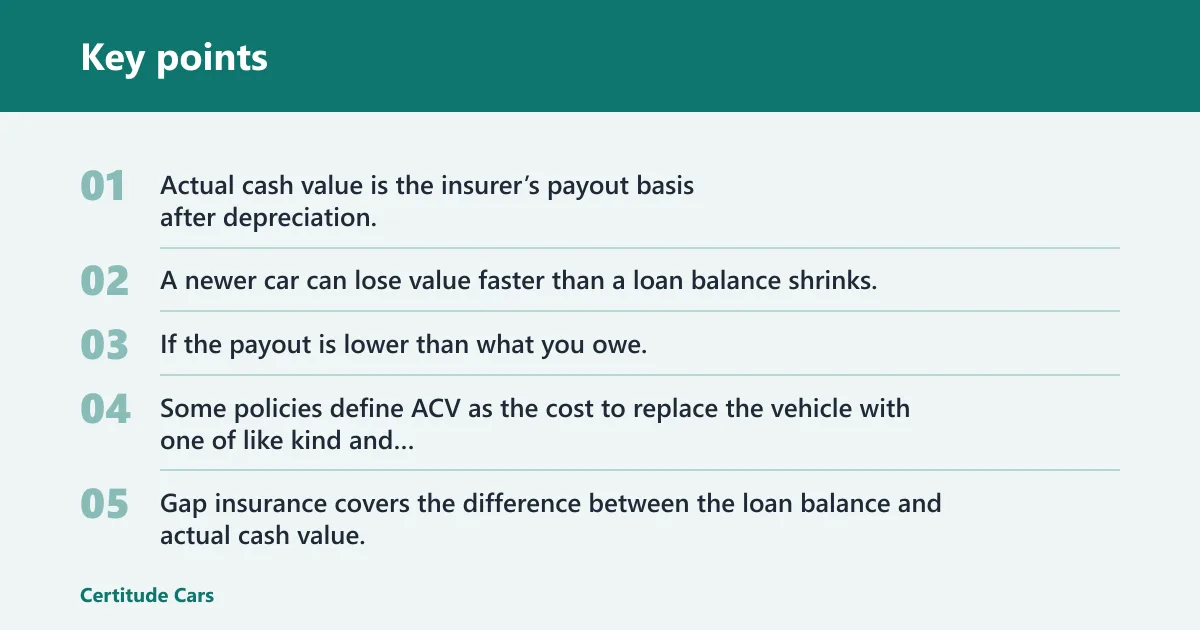
Actual cash value is the insurer’s payout basis after depreciation. A newer car can lose value faster than a loan balance shrinks. If the payout is lower than what you owe, the shortfall remains unless another coverage pays the difference. Some policies define ACV as the cost to replace the vehicle with one of like kind and quality, minus depreciation and physical condition, so the wording matters at claim time.
How gap insurance fills the shortfall
Gap insurance covers the difference between the loan balance and actual cash value. It is most relevant when a car is totaled and the loan balance is higher than the payout. It does not pay for repairs, and it is not automatic with full coverage. CFPB consumer guidance and lender materials describe gap coverage as optional protection against the gap between what the car is worth and what the borrower still owes, subject to the policy and loan terms.
When a loan balance can remain
If you owe $28,000 and the totaled-car payout is $24,000, the gap is $4,000 before any deductible issues. Without gap insurance, that balance can remain due. With gap insurance, the insurer may cover that shortfall if the policy and loan setup qualify. If the policy excludes negative equity, taxes, or certain fees, those amounts can still remain due even when gap coverage exists.
What full coverage does not pay
Full coverage still leaves gaps. Deductibles come out of your settlement. Policy limits cap how much the insurer pays. Rental reimbursement is optional. And no part of full coverage automatically pays every injury bill, every loan balance, or every claim that goes beyond the policy terms. State DOI guides and insurer forms also show that exclusions and endorsements can change the result even when a claim seems straightforward.
Deductibles and out-of-pocket costs
Collision and comprehensive claims usually require a deductible. That is the amount you pay before the insurer pays the rest. If the repair estimate is close to the deductible, filing a claim may not make sense. If the claim exceeds policy limits, you pay the amount above those limits. Some policy forms let you choose different deductibles for collision and comprehensive, so the out-of-pocket amount may differ by loss type.
Rental car coverage limits
Rental reimbursement is not guaranteed by full coverage. It is an optional add-on on many policies. If your car is in the shop after a covered claim, rental coverage may help with transportation costs, but only up to the policy’s daily and total limits. If the other driver is at fault, their insurer may owe reasonable rental costs under liability, but you may still need to rely on your own rental reimbursement if their claim is delayed or disputed.
Claims outside your policy limits
Full coverage does not erase liability exposure. If you cause serious damage or injury and the other person’s losses exceed your liability limits, you can still owe money. State minimum liability requirements vary by state, and meeting them does not mean your limits are high enough for every crash. State DOI consumer pages and the III both caution that minimum limits may be far below the cost of a serious accident.
How to handle a claim step by step
The cleanest claim path separates the immediate needs from the insurance pieces. Start with safety, then decide whether the loss is vehicle damage, injury, or both. That keeps you from asking the wrong coverage to pay the wrong bill. It also helps you preserve evidence for valuation disputes, fault determinations, and any rental reimbursement or towing questions.
- Tow and repair: If the car will not move safely, arrange a tow. Then file the claim under collision or comprehensive, depending on the cause.
- Medical treatment: Get care first if anyone is hurt. Then check MedPay, PIP, or uninsured or underinsured motorist coverage for the medical side of the claim.
- Total loss payout: If the car is totaled, ask for the actual cash value calculation and compare it with the loan balance. That is where gap insurance may matter.
- Third-party liability: If you caused the crash, report the damage and injuries to the other party through liability coverage. Keep photos, police details, and repair estimates together.
A common first-timer mistake is sending a medical bill to collision coverage because the crash damaged the car. That bill belongs under MedPay, PIP, health insurance, or a bodily-injury claim route, not under repair coverage for the vehicle. Another common mistake is assuming rental reimbursement is automatic; if the declarations page does not list it, the rental bill may be yours even when the repair claim is covered.
Frequently asked questions
Does full coverage cover everything after a car accident?
No. Full coverage usually means liability, collision, and comprehensive, but those cover different losses and still leave deductibles, exclusions, and policy limits. It may not pay your medical bills, may not cover a totaled-car loan gap, and does not replace optional add-ons such as rental reimbursement or gap insurance.
What does full coverage car insurance cover in an accident?
In a crash, full coverage usually points to collision for your car damage, liability for damage or injuries you cause to others, and comprehensive for losses away from a crash such as weather, theft, vandalism, and animal strikes. The exact payout depends on fault, policy limits, and deductibles.
Does full coverage pay for my own car damage after a crash?
Yes, if you have collision coverage. Collision pays for your vehicle damage after a crash whether you caused it or not, including hitting another vehicle or an object. You still owe the deductible, and the payout will not exceed the car’s covered value.
Does full coverage cover my medical bills after an accident?
Usually no. Full coverage by itself generally does not include your own medical bills. MedPay, PIP, and uninsured or underinsured motorist coverage are the main ways those costs may be paid, and some states require PIP or uninsured motorist coverage on certain policies.
If I’m at fault, what does full coverage pay for?
If you are at fault, liability can pay for the other driver’s damage and injuries, while collision can pay for your own car damage. Comprehensive does not apply to the crash itself. Your deductibles still apply, and you can still owe amounts above your liability limits.
Does full coverage include uninsured motorist coverage?
Not always. Full coverage usually refers to liability, collision, and comprehensive, while uninsured or underinsured motorist coverage is often separate. Some states require it, and it can be important for hit-and-run crashes, injuries caused by uninsured drivers, and certain property damage claims. Some insurer forms also vary on whether UM includes property damage at all, so the endorsement wording matters.
Do I need gap insurance if my car is totaled?
Gap insurance matters if your loan balance is higher than the car’s actual cash value after a total loss. That can happen when depreciation moves faster than loan paydown. If you owe more than the payout, gap insurance may cover the shortfall; otherwise, you may still owe money. CFPB and lender guidance describe gap coverage as useful, but optional, when loan balances and vehicle values are out of sync.