Why Is Liability Insurance Required for Drivers?
Liability insurance is required because state law makes the driver who causes injury or property damage financially responsible, and most states require proof of at least minimum coverage before you can legally drive. Without it, a crash can leave you paying claims, fines, license penalties, and repair or medical costs out of pocket. This guide explains what liability insurance pays, how state minimums work, and the edge cases for permitted drivers, occasional drivers, and New Hampshire.
Why states require liability coverage
States use liability insurance as a financial responsibility tool. The goal is direct: if you cause a crash, the bill should not fall on the injured driver, passengers, or public programs that may end up paying unpaid claims.
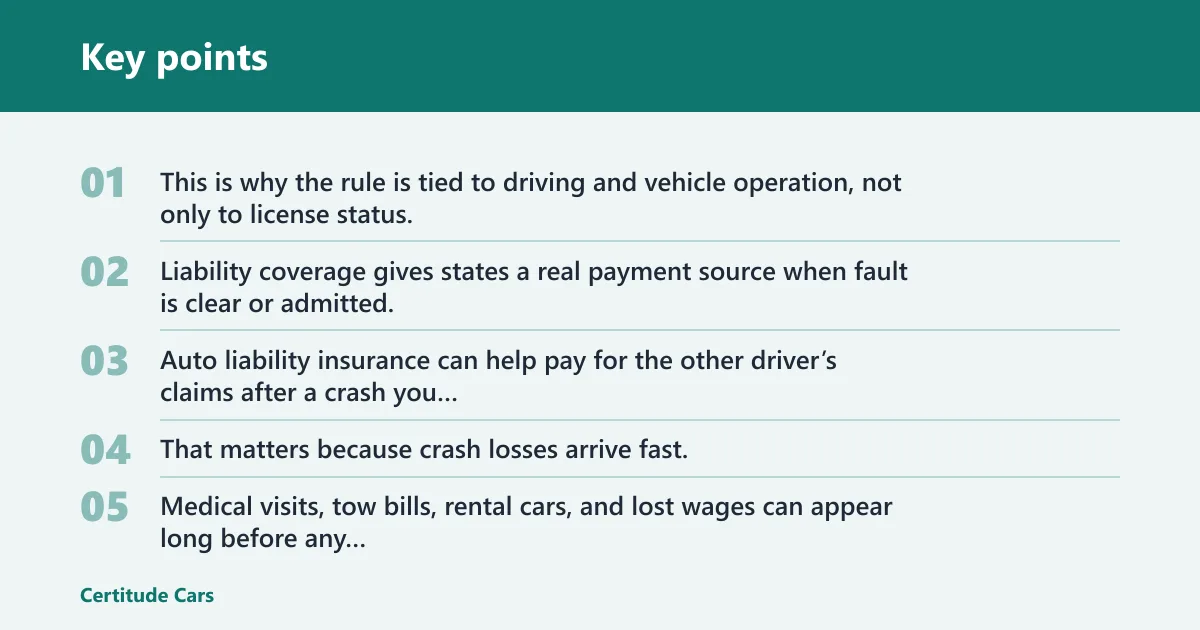
This is why the rule is tied to driving and vehicle operation, not only to license status. A valid license does not pay for damage. Liability coverage gives states a real payment source when fault is clear or admitted.
Shifting crash costs away from victims
Auto liability insurance can help pay for the other driver’s claims after a crash you caused. That matters because crash losses arrive fast. Medical visits, tow bills, rental cars, and lost wages can appear long before any lawsuit ends.
If the at-fault driver has no liability coverage, the injured person may have to pursue payment directly. State financial responsibility laws are meant to reduce that gap.
Why the rule follows financial responsibility laws
State financial responsibility laws set minimum insurance rules by state, not by federal law. They require proof that an at-fault driver can pay for damages if a crash happens. The exact limits, proof rules, and penalties vary by jurisdiction.
Some states require proof before registration, some before renewal, and some after a crash or stop. The legal demand is broader than “carry insurance because you drive.” It is “show you can pay if you cause harm.”
How this differs from a license requirement
Liability insurance is usually connected to operating or registering a vehicle, not merely holding a driver’s license. A person can be licensed and still violate the law by driving an insured vehicle without the coverage the state requires for that vehicle or use case.
That distinction matters for families, roommates, and borrowed cars. The question is often not only “is the driver licensed?” but “does this driver, vehicle, or use pattern satisfy state financial responsibility rules?”
What liability insurance pays for if I cause a crash?
Liability insurance pays for other people’s losses when you are at fault. It does not pay for your own car damage or your own injuries. The two main parts are bodily injury liability and property damage liability, and both are capped by the policy’s maximum payout.
Bodily injury liability
Bodily injury liability covers other people’s medical costs and lost wages when you are at fault. It can also respond to claims for pain and suffering. In a split-limit policy, this is often shown as the first two numbers, such as 20/40/10 or 50/100/50.
Property damage liability
Property damage liability covers damage to other people’s vehicles and property. That can include fences, trees, homes, and other stationary objects. In a split-limit policy, this is often shown as the third number.
What happens when losses exceed limits
Coverage limits are the insurer’s maximum payout. If medical bills, lost wages, vehicle repairs, and legal claims go beyond those limits, the remaining balance can still be owed by the at-fault driver.
Suppose a driver carries 25/50/25 and causes a crash with $80,000 in bodily injury claims. The policy can only pay up to its limits. The rest can become a personal debt, which may lead to collection efforts or a judgment.
How state minimum limits work
State minimum liability limits vary by state. Most minimums include a bodily injury per person limit, a bodily injury per accident limit, and a property damage limit. Those numbers tell you the most the insurer will pay, not the most the crash can cost.
Split limits and what the numbers mean
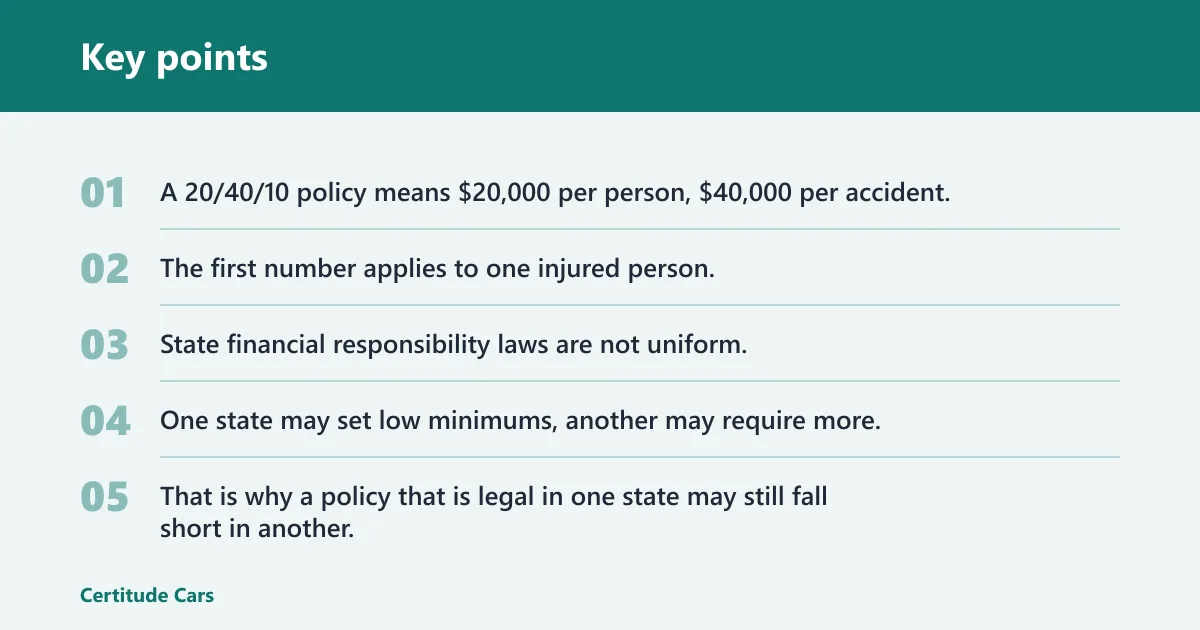
A 20/40/10 policy means $20,000 per person, $40,000 per accident, and $10,000 property damage per accident. The first number applies to one injured person, the second to all bodily injury claims in one crash, and the third to property damage claims in one crash.
Why minimums vary by state
State financial responsibility laws are not uniform. One state may set low minimums, another may require more, and some states add other coverage rules on top. That is why a policy that is legal in one state may still fall short in another.
Arizona minimum liability limits are set by statute at $25,000/$50,000/$15,000 for bodily injury and property damage minimums under Arizona law (A.R.S. § 28-4009). That is an example of how split limits are written, not a national standard. For a state-by-state overview, see Arizona minimum coverage.
What the minimums mean in a real claim
Minimums are a legal floor, not a safe ceiling. If a crash causes multiple injuries, a totaled vehicle, and roadside property damage, the claim can run far above the minimum very quickly. The smaller the limit, the sooner the driver is exposed.
Picture a rear-end crash that injures two people and damages a parked car and a mailbox. A policy that barely meets the state floor may not come close to covering every bill. That is where out-of-pocket exposure begins.
Does liability cover your own injuries?
No. Liability insurance is for other people’s losses, not your own. If you want help with your own medical bills, you need a different coverage type, such as personal injury protection in some no-fault states or uninsured and underinsured motorist coverage where it is required or available. For the coverage tradeoffs, see no-fault vs tort and uninsured motorist coverage.
How PIP fits in no-fault states
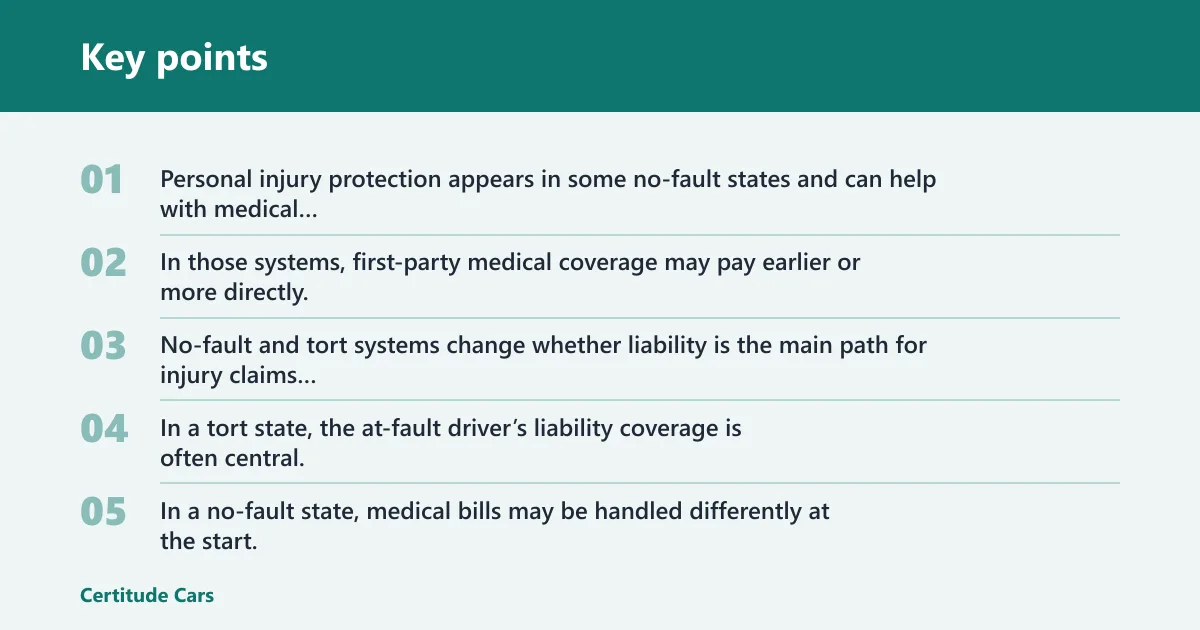
Personal injury protection appears in some no-fault states and can help with medical costs after a crash. In those systems, first-party medical coverage may pay earlier or more directly, while liability rules still address who pays for damage to others.
No-fault and tort systems change whether liability is the main path for injury claims after a crash. In a tort state, the at-fault driver’s liability coverage is often central. In a no-fault state, medical bills may be handled differently at the start.
Where uninsured motorist coverage fits
Uninsured and underinsured motorist coverage may be required in some states, and it is separate from liability coverage. It can help when the other driver has no insurance or too little to pay for your injuries or, in some states, related losses.
That protection matters because another driver’s legal duty does not guarantee payment. Liability coverage answers the question “who is responsible?” Uninsured and underinsured motorist coverage helps answer “who pays if the responsible driver cannot?”
Who needs liability coverage and why?
Most drivers need liability coverage because state law requires proof of financial responsibility before legal driving, registration, or renewal. The core exceptions are narrow and state-specific. New Hampshire is the best-known example of no up-front compulsory insurance, but it still applies financial-responsibility rules after a crash or other trigger under state law. Arizona requires minimum liability coverage for motor vehicle operation under A.R.S. § 28-4009.
| Driver type | Legal trigger | Minimum likely required | Risk if uninsured | If this is you |
|---|---|---|---|---|
| Standard owner-operator | State financial responsibility rules tied to driving and registration | State minimum liability limits, often split by bodily injury and property damage | Tickets, registration trouble, claim exposure, and personal payment for damages | Check your policy before renewal and before driving a newly bought car. |
| Permitted driver | Permission to use another person’s vehicle, plus the vehicle owner’s policy terms and state rules | Usually the owner’s liability policy applies first, but state rules and exclusions can change the result | Coverage gaps if the policy excludes you or if no valid policy follows the car | Ask whether you are listed, allowed, or excluded before borrowing the car. |
| Occasional driver | Intermittent use of a household or borrowed vehicle may still trigger insurance rules | Often the vehicle policy matters more than a separate driver policy, but regular use can change the picture | Claims may be denied or limited if you drive often without being properly rated or listed | If you drive the same car regularly, confirm whether the insurer expects you on the policy. |
| Leased/financed vehicle | Lease or loan contract plus state minimums | Often higher than state minimums because the lender or lessor may require more coverage | Contract default, forced coverage, and large out-of-pocket loss if the car is damaged or you cause a crash | Read the lease or loan paperwork; minimum state coverage may not satisfy the contract. |
| New Hampshire driver | Common exception to up-front mandatory insurance, but proof may still be required after a crash or other trigger | Financial responsibility proof can be required even when up-front insurance is not compulsory | Severe exposure after a crash if you cannot show ability to pay for damages | Do not assume “no mandatory policy” means “no responsibility.” |
| Commercial driver | Commercial auto and trucking rules, which are often stricter than personal-use rules | Commercial auto liability is required by most states; limits and contract demands can be higher | Business interruption, regulatory problems, and very large liability claims | Separate personal auto rules from commercial rules before operating for work. |
State comparison checklist for exceptions, proof triggers, and failure points
| State / scenario | Compulsory insurance exception? | Common proof trigger | Common failure case for permitted or occasional drivers |
|---|---|---|---|
| Arizona | No broad exception for private passenger vehicles; minimum liability coverage is required by statute (A.R.S. § 28-4009). | Registration, renewal, and law-enforcement or DMV checks tied to financial responsibility rules. | Borrowing a car that is insured, but not being sure the policy allows regular use or household use. |
| New Hampshire | Yes, up-front insurance is not generally compulsory for private passenger vehicles, but financial responsibility can still be required after a crash or violation under state law (RSA 264:15, RSA 264:16). | After a crash, suspension, or another financial-responsibility event. | Assuming “no mandatory insurance” means no post-crash proof requirement or no personal liability exposure. |
| Other tort states | Usually no broad exception for ordinary drivers. | Registration, renewal, traffic stop, or post-crash investigation. | Driving a household car without confirming the policy lists the right drivers or excludes none of them. |
Checklist: Verify whether the state requires proof before registration, whether the vehicle policy covers permissive use, whether regular drivers must be listed, whether the vehicle is financed or leased, and whether the state has a post-crash financial-responsibility rule even if it does not require up-front insurance.
What if you drive without it?
Driving without liability insurance can bring penalties before a crash and major costs after one. States may issue tickets, suspend registration, or impose license-related consequences. If you cause a crash, the injured person can sue you directly for damages you should have paid through insurance.
- Expect a citation, fee, or registration problem if police or the DMV discover the lack of required coverage.
- Expect personal exposure for medical bills, vehicle repair, lost wages, and other damage if you are at fault.
- Expect collection risk if a court enters a judgment and you still do not pay.
A common first-time mistake is assuming the other driver’s insurance will handle everything. If you caused the crash, the claim usually starts with your liability coverage. Without it, the other side may pursue you directly.
Judgments can lead to collection steps, including wage garnishment risk in some situations. The exact collection tools depend on state law, but the basic problem is the same: a lack of insurance can turn a crash into a long-term debt. For broader consequences, see driving without insurance penalties and SR-22.
When minimum coverage is not enough
Higher limits reduce the chance of out-of-pocket claims. That matters because a serious injury crash can exceed bare minimums quickly, especially when multiple people are hurt or several vehicles and property items are damaged.
WalletHub gives an average liability insurance cost of $1,407 per year. That figure is not a promise of what any driver will pay, but it shows why many drivers compare the price of higher limits against the much larger cost of being underinsured.
Why larger claims outgrow state minimums
Medical treatment, lost wages, and pain-and-suffering claims can rise beyond the first payout very fast. A policy that looks adequate on paper may be thin once more than one person is injured, or once a crash involves a newer vehicle and roadside property damage.
Why leased or financed cars need a closer look
Leased or financed vehicles often come with contract terms that are stricter than the state floor. The lender or lessor may want more than the legal minimum because they also care about the vehicle’s value and the risk of a total loss.
In a financed car, state minimum liability may satisfy one rule and still fail another. Read the contract and policy together, not separately.
Frequently asked questions
Why is liability insurance required for drivers?
It is required so the driver who causes harm has a financial source for other people’s losses. State financial responsibility laws try to keep crash costs from falling entirely on victims or public systems. Most states require proof of minimum liability coverage before you can drive legally.
What does liability insurance pay for if I cause a crash?
It can pay the other driver’s bodily injury and property damage claims if you are at fault. Bodily injury liability may cover medical costs, lost wages, and pain and suffering. Property damage liability may cover another vehicle, a fence, a tree, a home, or another stationary object.
Is liability insurance required in my state?
In most states, yes. The exact rule depends on where you live and how the vehicle is used or registered. Some states use no-fault rules, some require uninsured motorist coverage, and New Hampshire is often cited as an exception to up-front compulsory insurance. Under New Hampshire law, however, drivers can still face financial-responsibility requirements after a crash or other triggering event (RSA 264:15, RSA 264:16).
What happens if I drive without liability insurance?
You can face tickets, registration problems, or license-related penalties before a crash. If you cause a crash, you may have to pay claims yourself, and a lawsuit can lead to a judgment. That judgment can create collection risk and long-term financial damage.
Do permitted drivers need insurance?
Often the vehicle owner’s policy is the first place to look, but the answer depends on state law and policy terms. A permitted driver may be covered under the owner’s liability policy, yet exclusions, regular-use rules, or lapse in coverage can change the result fast.
What is the minimum liability insurance required in Arizona?
Those are minimums, not a guarantee that they will cover a serious claim.
Sources
Arizona Revised Statutes § 28-4009; New Hampshire Revised Statutes Annotated §§ 264:15 and 264:16; state DMV and insurance department guidance on financial responsibility and proof of insurance requirements.