Battery Light on but Car Runs Fine: What It Means
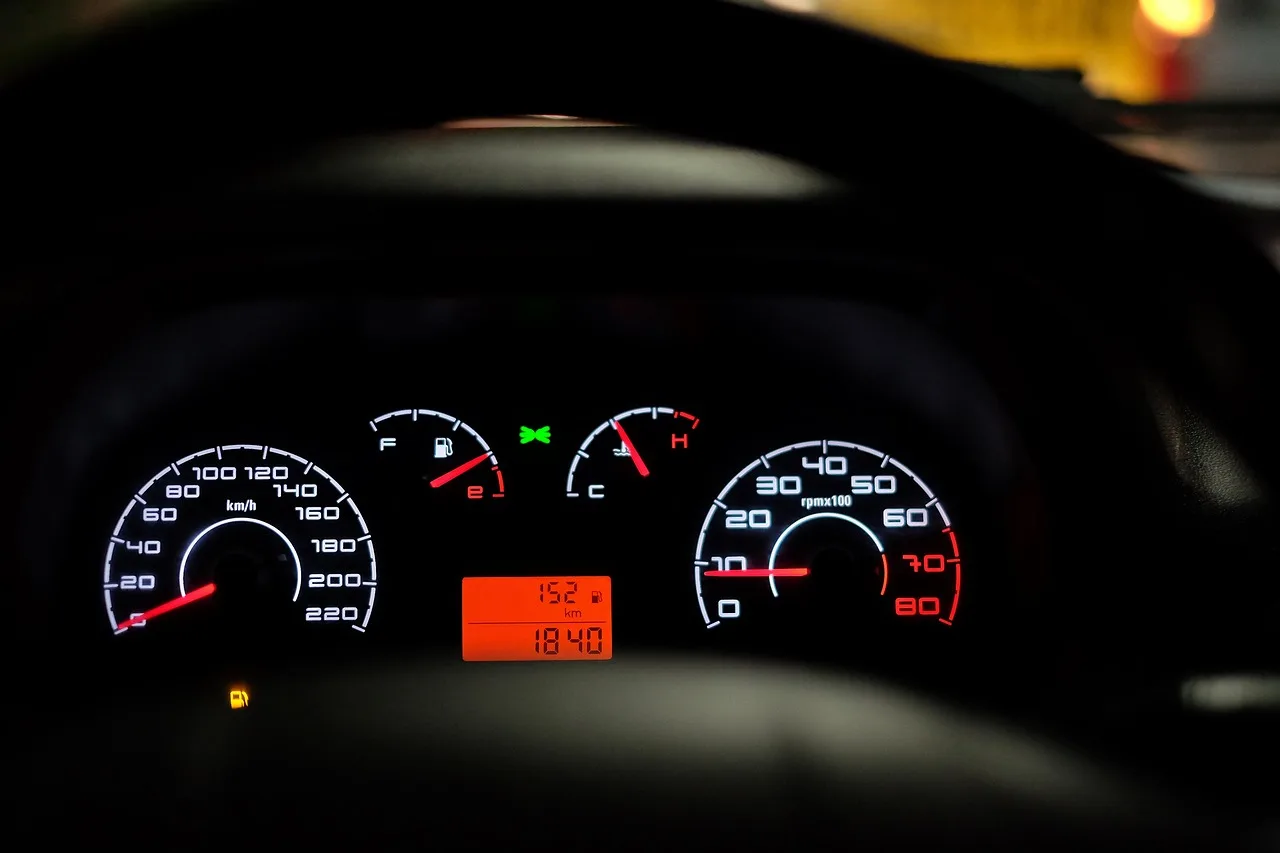
A battery light with normal drivability usually points to a charging-system fault, a loose serpentine belt, a bad fuse, wiring corrosion, or a voltage regulator issue, not always a failed alternator. Ignore it and the car can run on battery reserve until voltage drops enough to stall. This guide starts with the cheapest checks, then shows how to separate a simple electrical fault from a charging failure before you replace major parts.
What the warning light usually means
When the engine is running, the battery warning light usually means the battery is not being charged properly. That does not mean the battery itself is always the first failure. It means the charging system, wiring, belt drive, or sensor inputs are interrupting the alternator’s output or the vehicle’s control of that output.
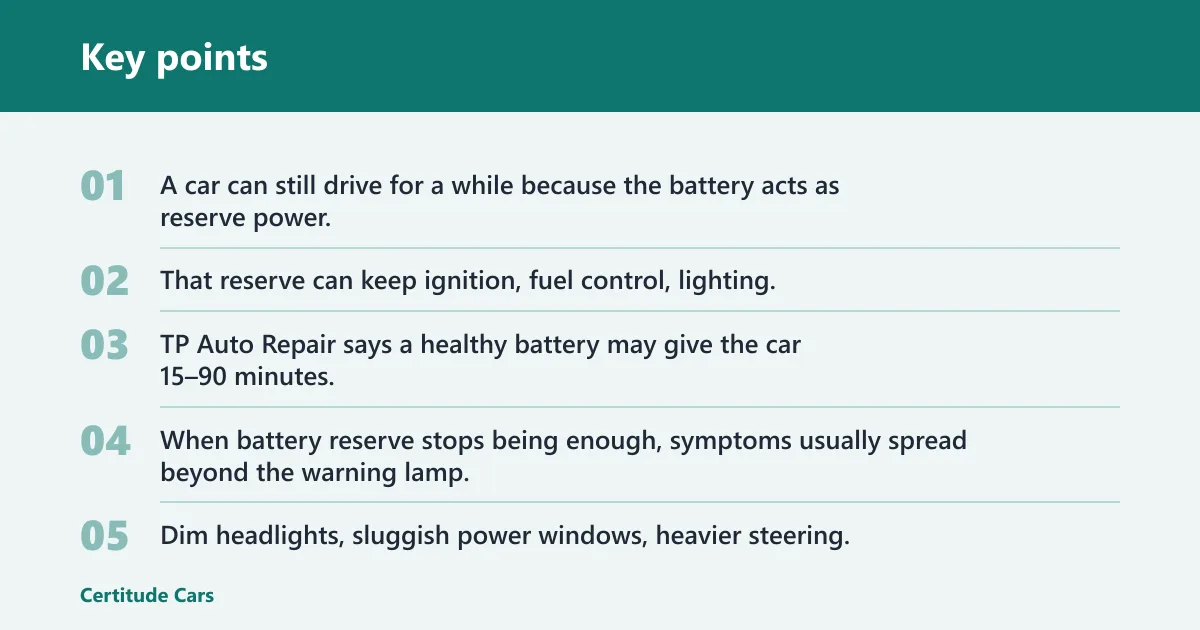
A car can still drive for a while because the battery acts as reserve power. That reserve can keep ignition, fuel control, lighting, and the dash alive for a short period even if charging has stopped. TP Auto Repair says a healthy battery may give the car 15–90 minutes, but that window shrinks fast if headlights, blower motors, heated rear glass, or power steering load the system.
When battery reserve stops being enough, symptoms usually spread beyond the warning lamp. Dim headlights, sluggish power windows, heavier steering, or a rough idle at low speed all raise urgency. SlashGear specifically notes sluggish power windows as a common symptom.
Say your dash lights stay bright at idle, but the battery lamp appears after the rear defogger and blower fan are switched on. That pattern points more toward charging output falling under load than toward a dead battery alone.
Steady, flickering, or flashing?
A steady light, a flicker, and a flashing warning do not mean the same thing. A steady lamp usually points to a persistent charging fault. A flicker often means intermittent output from the alternator, belt slip, loose connections, or an unstable sensor signal. A flashing lamp can mean the system is losing charging more abruptly and should be treated as higher risk.
Steady light and the usual fault pattern
A steady battery light often points to a charging system that may be underperforming consistently. Common causes include a bad alternator, a bad voltage regulator, loose or corroded battery cables, or a blown charging-system fuse or fusible link. wikiHow and VehicleFreak both identify bad alternator and cable problems among the common causes.
Flickering light and intermittent charging loss
A flickering lamp often tracks engine speed, bumps, or electrical load. That pattern suggests belt slip, a loose terminal, a failing alternator brush set, worn bearings, or a poor ground strap. If the flicker appears when the wheel is turned or accessories switch on, check for voltage drops before assuming the alternator is finished.
Flashing light and higher urgency signs
A flashing light, especially with dimming lights or heavy steering, calls for prompt attention. It can mean output is dropping in and out, which can leave the battery carrying the car alone for part of the drive. If the lamp flashes and the car begins to misbehave, reduce electrical load and head for a safe stop.
Battery light matrix
This matrix ranks the most likely causes by symptom pattern and test result. Start with the cheapest likely check, then move up only if the earlier item does not fit the evidence. Many cars that still feel “fine” are already running on battery reserve, so the key question is not whether the engine runs, but whether the charging system is keeping up.
| Symptom pattern | Battery resting voltage | Running voltage | AC ripple | What to check next | Likely repair tier |
|---|---|---|---|---|---|
| Steady light, no dimming, no squeal | About 12.6V | Below 13.5V, or not stable on a smart-charging car | Normal, under 0.5V AC | Charging fuse or fusible link, terminal corrosion, ground strap | Cheap to moderate |
| Flickering light at bumps or idle changes | About 12.6V or lower | Moves up and down with engine speed | Normal, under 0.5V AC | Serpentine belt, tensioner, clamps, alternator connector | Cheap to moderate |
| Steady or flickering light with dim lamps, heavy steering | Below about 12.4V before start | Low and falling with accessories on | May stay normal | Alternator output and regulator control | Moderate to expensive |
| Light plus whining, bearing noise, or burning smell | Any | May be low or erratic | May be high or irregular | Alternator bearings, rotor, brushes, diode pack | Moderate to expensive |
| Light with battery voltage normal but warning persists | About 12.6V | Varies by model and control strategy | Normal | IBS or battery temperature sensor, PCM command, wiring | Cheap to moderate |
| Light with radio noise, flicker, or pulsation in electronics | Any | May look normal on a simple meter | Above 0.5V AC | Alternator diode fault | Moderate to expensive |
The cheapest next check is usually the battery terminals and cable clamps. After that, look at the belt and ground path. Only then should the alternator be treated as the main suspect.
What should you check first?
Start with visible, low-cost faults before buying a major part. Loose or corroded battery cables can trigger the light, and a slipping belt can make a good alternator look bad. Clean the easy stuff first. That often avoids an unnecessary alternator replacement.
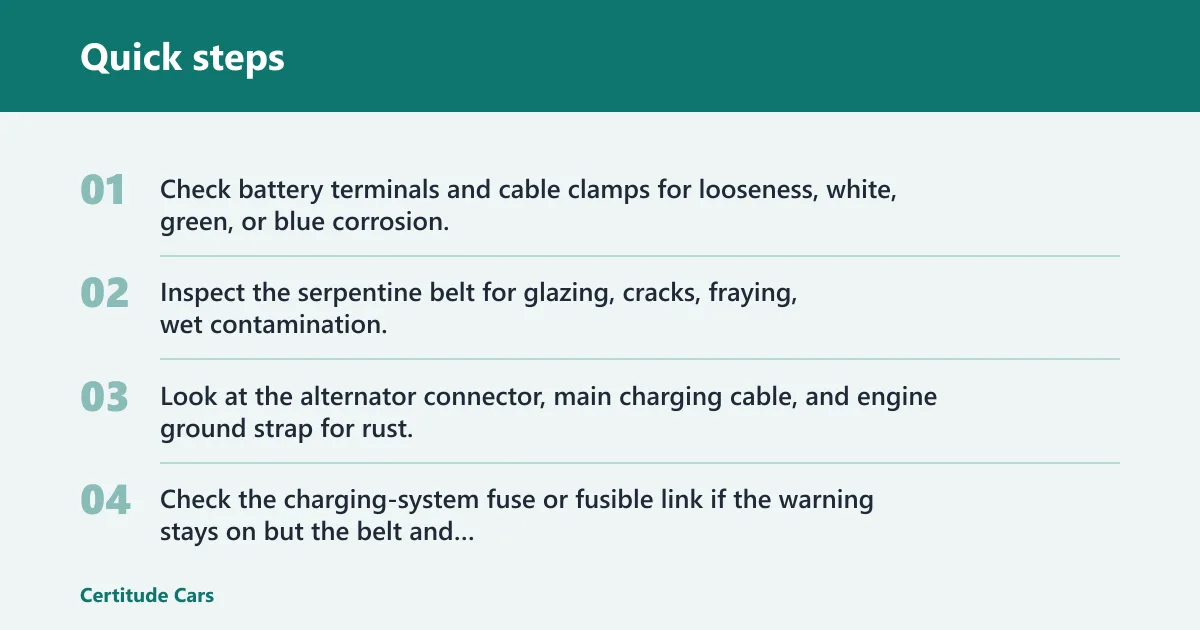
- Check battery terminals and cable clamps for looseness, white, green, or blue corrosion, and damaged cable ends.
- Inspect the serpentine belt for glazing, cracks, fraying, wet contamination, or obvious looseness.
- Look at the alternator connector, main charging cable, and engine ground strap for rust, broken strands, or poor contact.
- Check the charging-system fuse or fusible link if the warning stays on but the belt and terminals look sound.
Battery terminals and cable clamps
Battery terminals and cable clamps should be tight and clean before you blame the alternator. Corrosion often appears white, green, or blue. A loose clamp can let the system voltage wander enough to trigger the light, especially when the engine vibrates or electrical load changes.
Serpentine belt and tensioner condition
A slipping serpentine belt can absolutely cause the battery light to stay on. Wear, glazing, looseness, wet belt surfaces, and cracking can all reduce alternator drive. Many modern cars use an automatic tensioner, so the check is often about belt condition and tensioner behavior rather than a simple manual adjustment.
Ground strap and charging fuse or fusible link
A rusted, frayed, or poorly attached ground strap can mimic a bad alternator because the charging circuit cannot complete the return path cleanly. A charging-system fuse or fusible link can also interrupt alternator output. That fault can leave the battery lamp on even if the alternator itself is capable of charging.
Suppose the battery posts look clean, but one engine ground strap is green with corrosion near the body attachment point. That single fault can create enough resistance to cause a warning light and weak charging symptoms without any alternator failure at all.
How do you test charging voltage?
Use a digital multimeter at the battery posts for the basic checks. A healthy resting battery is commonly about 12.6V, and most cars should show roughly 13.5 to 14.7V while running. On some smart-charging systems, the reading may vary by design, so you should compare the value with the vehicle’s charging strategy and the service information for your model.
Resting battery voltage check
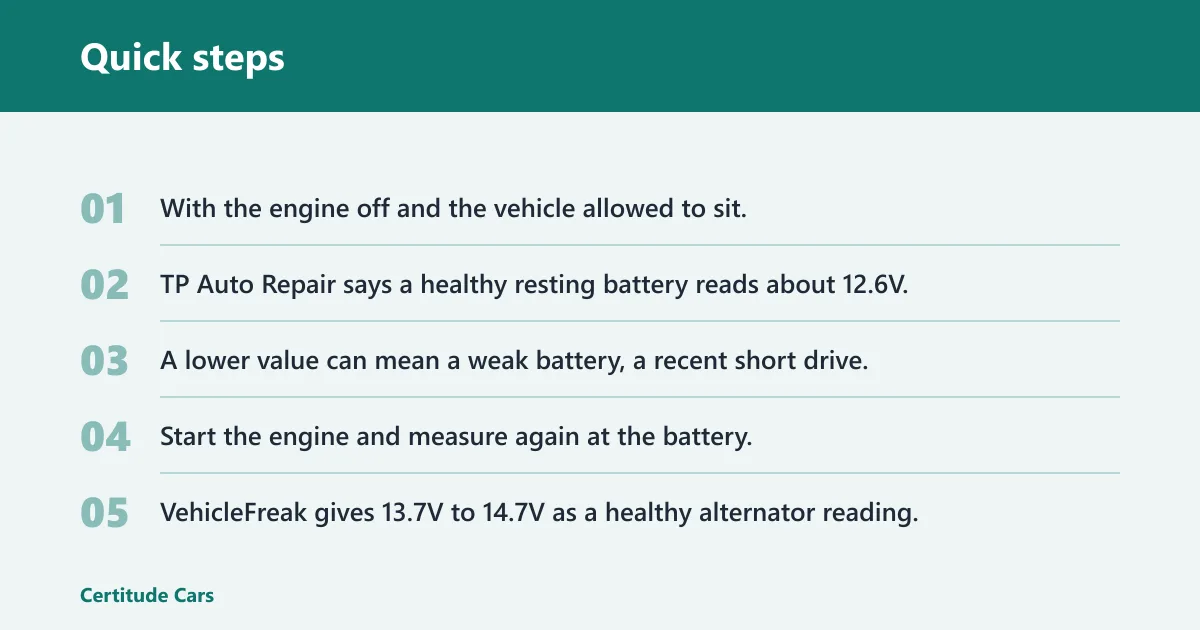
With the engine off and the vehicle allowed to sit, measure DC voltage across the battery posts. The same source says a healthy resting battery reads about 12.6V. A lower value can mean a weak battery, a recent short drive, or a battery that has not fully recovered after repeated undercharging.
Running voltage check with the engine
Start the engine and measure again at the battery. VehicleFreak gives 13.7V to 14.7V as a healthy alternator reading, and AutotoRide says a healthy system shows over 13.5 volts. That range is a useful guide on many vehicles, but smart-charging systems can move the voltage up or down based on temperature, engine load strategy, and battery state.
Why temperature and smart-charging logic can change the reading
Modern charging systems do not always hold one fixed number. Some vehicles use the PCM to command alternator output, and some use an Intelligent Battery Sensor or battery temperature sensor to modify charging behavior. A lower or variable reading is not automatically a failure if the system is deliberately managing voltage for fuel economy or battery protection.
AC ripple and diode fault clues
A digital multimeter can also check AC ripple. Excessive ripple usually points to alternator diode failure. A common practical threshold is more than about 0.5V AC at the battery with the engine running. If ripple is above that, suspect the alternator before replacing the battery.
Alternator or voltage regulator?
The alternator is the main charging component while the engine runs. The voltage regulator controls how hard it charges. A failed alternator can stop charging, but a bad regulator can cause low or high charging voltage even when the alternator still spins. Some regulators are built into the alternator, while others are controlled by the PCM.
Common alternator failure modes
Common alternator faults include worn brushes, failed diodes, a damaged rotor, and bearing wear. Brushes can create intermittent charging loss. Bearings can create noise and drag. A bad diode can still let the alternator charge some of the time, which is why the car may run normally at first.
Built-in regulator versus PCM control
Do not assume every charging fault means the alternator’s internal regulator is bad. On some vehicles, the regulator is built into the alternator. On others, the PCM controls charging strategy. That means the warning can come from control logic, sensor input, or wiring, not only from the alternator hardware itself.
AC ripple and diode fault clues: if the DC charging voltage
If the DC charging voltage looks reasonable but the light stays on and electronics act odd, check ripple. A high ripple reading suggests a diode problem in the alternator rectifier. That clue matters because a diode fault may not always show up as a simple low-voltage reading.
Smart-charging sensors and ground faults
Smart-charging systems can confuse the diagnosis if the sensor inputs are wrong. An IBS or battery temperature sensor may trigger a false or unstable charging warning on some vehicles. A poor engine ground or chassis return can do the same thing, because the system sees voltage drop where it expects a clean path.
IBS or battery temperature sensor issues
If the warning appears after battery work, sensor replacement, or electrical repairs, check whether the vehicle needs a sensor relearn or similar procedure. Battery registration or coding applies only to certain makes and systems. Do not assume every car needs it. Check the manufacturer’s listing for your model.
Engine ground and chassis return problems
The ground strap or engine ground wire is easy to overlook. Rust, fraying, or a loose attachment can create a charging complaint that looks like a bad alternator. If voltage at the battery is low but the alternator case is not well grounded, the meter can mislead you unless you inspect the return path carefully.
When battery registration or coding applies
Some late-model vehicles need battery registration after a replacement so the charging system can reset its strategy. That is not universal. If the owner’s manual or service data does not call for it, do not add that step by default.
Picture a sedan with start-stop equipment that shows a battery lamp after a new battery is fitted. The terminals are tight, the belt is sound, and the alternator tests okay. In that case, the next check is the battery sensor or the vehicle’s charging control logic, not another alternator.
Frequently asked questions
Why is my battery light on but my car runs fine?
Because the engine can keep running on battery reserve for a while after charging weakens or stops. The light often means the battery is not being charged properly, not that the engine will quit instantly. Treat it as an early warning and check the charging system before the reserve runs down.
Can I keep driving if the battery light stays on?
Only long enough to get to a safe place or a repair shop, and only if the car still behaves normally. Reduce electrical load by switching off extras such as heated glass and extra accessories. If lights dim, steering gets heavy, or the lamp flashes, stop driving as soon as it is safe.
Is it the battery or alternator when the light comes on while driving?
Either is possible, but the alternator and its control circuit are more common suspects while the engine is running. A weak battery can contribute, especially if it is near the end of its life, but a charging fault usually explains the light more directly. Test voltage before replacing parts.
What should I check first when the battery light comes on?
Check the battery terminals, cable clamps, serpentine belt, ground strap, and charging fuse or fusible link before you buy an alternator. Those items are cheaper and faster to inspect, and they often cause the same warning. Clean and tighten connections first, then retest the charging voltage.
How do I test alternator voltage with a multimeter?
Measure DC voltage across the battery with the engine off, then again with the engine running. A healthy resting battery is about 12.6V, and many running systems should show roughly 13.5 to 14.7V. Also check AC ripple; more than 0.5V AC points toward alternator diode trouble.
Is a flashing battery light different from a steady battery light?
Yes. A steady light often points to a constant charging fault. A flickering or flashing light suggests intermittent loss of output, belt slip, loose connections, or unstable control. If it flashes and the car begins to dim, hesitate, or steer heavily, treat it as more urgent than a steady lamp.