How Does MPG Work in a Car?
By the editorial team
MPG is miles driven divided by gallons used. Higher figures mean the car used less fuel per mile. It changes with speed, traffic, idling, load, route, and weather, so a single number can mislead you if you treat it as fixed. This guide explains how to read MPG, why dashboard and pump figures differ, and what changes real-world results trip to trip. For related reading, see how to calculate MPG manually, tyre pressure and fuel economy, hybrid MPG, MPGe explained, and fuel cost per mile.
Miles per gallon explained
Miles per gallon, or MPG, tells you how far a car travels on one gallon of fuel. If a car returns 40 MPG, it uses less fuel per mile than a car that returns 30 MPG. The figure moves with real conditions, not just the brochure. Route, weather, traffic, and load all shift it.
You can also read fuel use the other way around. Lower consumption means fewer gallons used for the same distance. In many markets, the same idea is shown as L/100 km instead of MPG.
Official fuel-economy labels and model data are published by EPA FuelEconomy.gov, while manufacturers’ owner’s manuals explain how onboard fuel-economy displays are calculated and reset. Those sources matter because MPG is usually a measured average, not a fixed property of the car.
MPG versus L/100 km
MPG rises when efficiency improves. L/100 km falls when efficiency improves. They describe the same thing from different angles, which is why the number can look “better” in one format and “worse” in the other.
For example, a car that uses 5 litres to cover 100 kilometres is efficient; the MPG equivalent would be higher than a car that needs 7 litres. The direction is the same even though the scale changes.
How do you calculate MPG?
To calculate MPG, divide the miles driven by the gallons of fuel added after that distance. The basic formula is: MPG = miles driven ÷ gallons used. A trip meter or odometer gives the distance, and the fuel receipt gives the gallons.
Using miles and gallons added
Fill the tank, reset the trip meter, drive normally, then refill to the same point. If you drove about 312 miles and added about 9.5 gallons, the calculation works out to about 32.8 MPG. That is a real-world average for that stretch of driving.
- Fill the tank to a repeatable point.
- Reset the trip meter or note the odometer reading.
- Drive the car as usual.
- Refill to the same point.
- Divide miles driven by gallons added.
Why an odometer or trip meter matters
Without a distance reading, the calculation falls apart. A trip meter is usually the easiest tool because it records the exact miles between fill-ups. That makes it the best check against the car’s onboard display.
Say your car shows 280 miles since the last fill and the pump takes 8 gallons to refill it. The manual result is 35 MPG. If the dashboard shows 38 MPG, the difference may come from how the computer estimates fuel use during that trip.
Why does dashboard MPG differ?

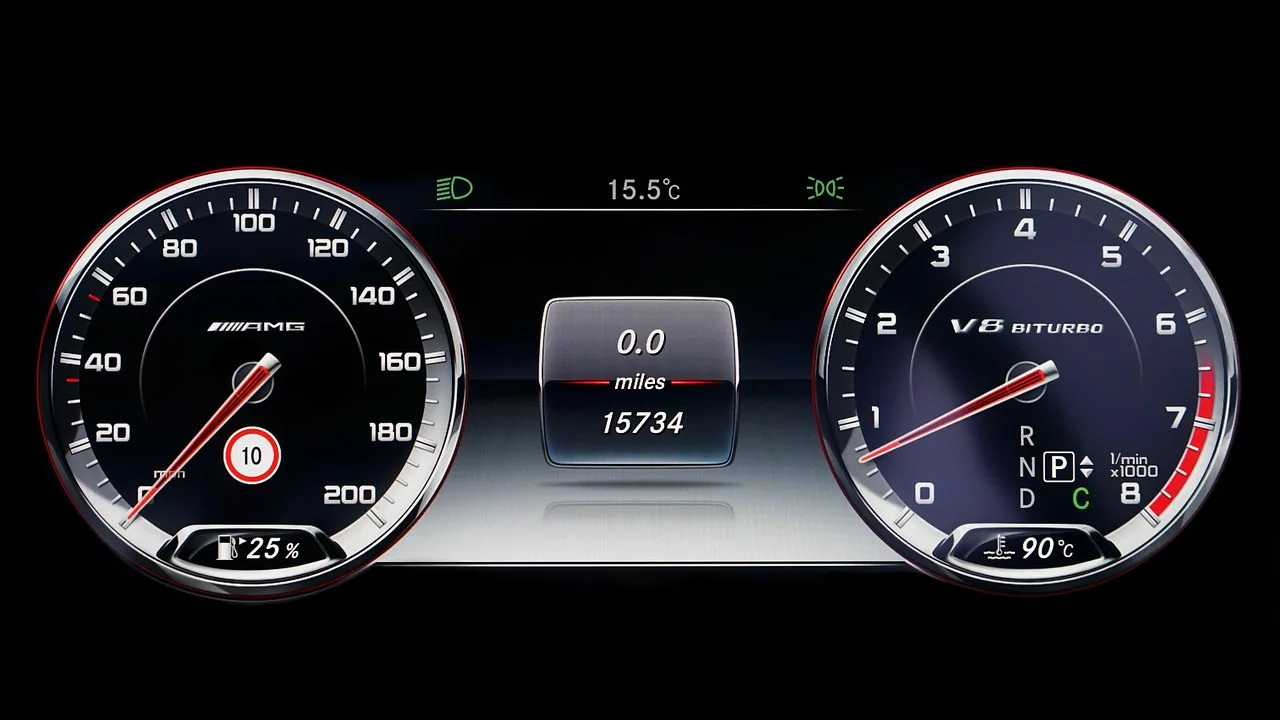
Dashboard MPG is an estimate, not a pump measurement. The trip computer usually uses sensor data and ECU estimates to show instant MPG and average MPG. That makes it useful for spotting patterns, but it can differ from a manual fill-up calculation, especially on short trips or after lots of idling. Owner’s manuals from major manufacturers commonly note that display readings are approximate and can be affected by driving history, fuel level sensing, and reset timing.
Instant MPG versus average MPG
Instant MPG changes every few seconds. Lift off the throttle on a gentle downhill and the number may jump. Press harder uphill or sit in traffic and it may drop fast. Average MPG smooths those swings over a trip or tank.
That is why one screen can say 12 MPG in stop-start traffic and another can show 34 MPG for the same day’s driving. Both can be correct.
Sensor data and ECU estimates
The display is only as good as the data feeding it. Small differences in injector timing, fuel pressure estimation, or how the car handles idle fuel cut can shift the reading. Most systems are close enough for monitoring, but not always close enough to replace a fill-up check.
Why fill-up figures can differ
Manual MPG can disagree with the dashboard for practical reasons. Fuel nozzles stop at slightly different points, the tank may not be filled to exactly the same level each time, and the computer may not count every edge case the same way the pump does.
A common first-timer mistake is comparing a single trip computer number with one refill and treating the gap as a fault. One reading is an estimate. The other is a volume-based check across the whole tank.
Dashboard MPG vs manual MPG
| Method | Best for | Typical causes of over/under-reading | When to trust it most |
|---|---|---|---|
| Dashboard MPG | Quick trend spotting and driving feedback | Reset timing, short trips, idling, sensor estimation, fuel cut behavior | Best during a trip or when you want instant coaching, not precise tank totals |
| Manual pump MPG | Tank-to-tank accuracy and cost tracking | Pump shut-off variation, fill level differences, rounding on receipts | Best across several fill-ups, especially for comparing real running costs |
What changes fuel economy?
Fuel economy changes because the engine has to work against real conditions. Traffic, speed, hills, temperature, load, tyre pressure, and servicing all matter. MPG is not a fixed spec that the car carries everywhere; it is the result of how hard the car has to work on that journey.
Traffic, speed, and terrain
Urban stop-start traffic usually hurts MPG because the car burns fuel to move off from rest again and again. Motorway cruising is often better because the speed is steadier. Hills, headwinds, and repeated acceleration all raise fuel use.
Load, aerodynamics, and tyre pressure
Passengers and luggage increase fuel use because the engine must move more mass. Roof racks and open windows can add drag, especially at higher speeds. Underinflated tyres increase rolling resistance, which also lowers MPG. Tyre maintenance guidance from reputable sources such as the Tyrewise campaign explains that incorrect pressure increases resistance and can reduce economy.
Heavier vehicles generally use more fuel, all else equal. That is one reason a larger SUV and a small hatchback rarely return the same result on the same route.
Maintenance and engine condition
Poor servicing can lower efficiency. Correct tyre pressure, clean filters where specified, and proper engine maintenance help the car work as intended. If something is wrong with sensors, ignition, or emissions control, fuel use can rise without any change in your driving.
MPG reality check
This table shows how the same car can return very different MPG figures depending on the job. The point is not a single “best” number. The point is that route and use change the result.
| Scenario | Expected MPG direction | Main reason it changes | Practical takeaway |
|---|---|---|---|
| City commute | Usually lower | Stop-start traffic, idling, repeated acceleration | Expect MPG to sit below motorway figures, even in a healthy car. |
| Steady motorway | Usually higher | Constant speed and fewer stops | Use this as a cleaner comparison point for long-trip fuel economy. |
| Cold short trips | Much lower | Cold engine, enrichment, limited warm-up time | Short winter errands can look poor even if the car is fine. |
| Towing | Lower | Extra weight and higher engine load | Expect a clear MPG drop and plan fuel stops more often. |
| Roof rack use | Lower | More drag at speed | Remove the rack when you do not need it. |
| Hybrid stop-start driving | Often higher in town | Electric assist and engine-off running at low speed | Hybrids often look strongest in slow traffic, not on open roads. |
Picture a small petrol hatchback on a 4-mile winter school run. The engine stays cold, the heater is on, and the car never settles into steady cruising. The dashboard may show poor MPG, and the fill-up result may be worse still because the warm-up penalty makes up a larger share of the trip. In owner’s manuals, this is why trip averages are treated as guidance rather than a promise.
How do petrol, diesel, hybrid, and EVs compare?
Petrol, diesel, hybrid, and electric cars do not read the same way in fuel-economy terms. Petrol and diesel are both usually measured in MPG. Hybrids still use MPG, but their result often improves in low-speed traffic. Electric cars use MPGe instead of MPG, because they do not burn fuel.
Petrol versus diesel
Diesel cars often return better MPG than similar petrol cars on long, steady runs because diesel engines are efficient under load and at lower cruising speeds. Petrol cars can be smoother and sometimes more suitable for shorter, lighter use. The better choice depends on how you drive, not on MPG alone.
Why hybrids improve in city driving
Hybrid systems can recapture energy during braking and use electric assist to reduce engine work in traffic. That often improves MPG in stop-start conditions. On a steady motorway run, the benefit may shrink because the car spends less time in low-speed electric assist. For a deeper breakdown, see hybrid MPG.
Why electric cars use MPGe instead of MPG
Electric vehicles do not use gallons of fuel, so MPG does not apply in the usual way. They use MPGe, which compares electrical energy use to a fuel-equivalent number. Keep that separate from MPG when you compare cars, or the numbers will mislead you. The EPA’s MPGe guidance on FuelEconomy.gov is the standard reference for this comparison: MPGe explained by FuelEconomy.gov.
How fuel economy affects running cost
MPG also tells you something practical: fuel cost per mile. If fuel costs £1.50 per litre, a car that uses less fuel per mile costs less to run on the same route. Higher MPG means lower cost per mile, though the exact figure depends on local fuel prices.
For a quick check, divide the price of fuel by miles per gallon after converting units for your market, or use your car’s average MPG and a known fill-up cost. That gives a rough cost-per-mile view, which is often more useful than a brochure number.
Frequently asked questions
How does mpg work in a car?
MPG works by comparing distance to fuel used. If the car travels more miles on each gallon, its MPG is higher and its fuel economy is better. The number changes with driving style, traffic, terrain, temperature, load, and how long the engine spends idling or warming up.
How does fuel economy work in a car?
Fuel economy is the result of how much fuel the car needs to move a given distance. Speed, acceleration, gear choice, road gradient, vehicle weight, and aerodynamics all affect it. A steady, lightly loaded car on a level road usually uses less fuel than one in stop-start traffic.
How many miles per gallon does my car do?
The best way to find out is a manual fill-up calculation. Record miles driven, refill the tank to the same point, and divide miles by gallons added. That gives a real-world average for your use, which is more useful than guessing from a single dashboard screen.
How does mpg work for electric cars?
Electric cars do not use MPG in the usual sense because they do not burn fuel. They use MPGe, which compares electrical energy use with a fuel-equivalent figure. If you want to compare EV efficiency, look at MPGe or energy use per distance, not MPG.
What mpg does my car do?
There is no single answer that fits every journey. Your car may return one MPG figure in city traffic and a much better one on a long motorway run. The most reliable answer comes from several tank calculations over normal driving, not from one short trip.
Quick checklist to improve MPG
- Keep tyres at the manufacturer-recommended pressure.
- Remove roof racks and extra load when you do not need them.
- Avoid hard acceleration and harsh braking.
- Use steady speeds where traffic and limits allow.
- Limit short cold trips when you can combine errands.
- Service the car on schedule and fix warning lights promptly.
- Compare tank averages, not one-off dashboard readings.
Mini troubleshooting: sudden MPG drop
If MPG falls sharply, start with the easy checks before assuming a fault. A sudden change is often caused by weather, traffic, tyre pressure, load, or a trip pattern shift rather than a major mechanical issue. The goal is to separate normal variation from a genuine problem.
- Check tyre pressures, especially after a temperature drop.
- Think about recent route changes, towing, roof loads, or idling.
- Look for warning lights, rough running, or delayed warm-up.
- Review whether the drop is from one short trip or several tanks.
- Compare dashboard MPG with a manual refill calculation.
Sources: EPA FuelEconomy.gov: Fuel economy guidance and ratings, MPGe explained by FuelEconomy.gov; manufacturer owner’s manuals for trip computer and fuel-economy display behavior; Tyrewise on tyre pressure and rolling resistance: Tyrewise.