Engine Horsepower vs Torque: What’s the Difference?
Horsepower tells you how quickly an engine can keep work going at speed, while torque tells you how hard it pulls, especially from low revs. Choose torque for towing and clean low-speed pull, horsepower for stronger acceleration and higher-speed passing. Mix them up, and you can buy the wrong car for the job. This guide shows how each number affects towing, overtaking, and everyday driving, plus how to read spec sheets correctly.
| Decision factor | Engine horsepower | torque | Winner |
|---|---|---|---|
| Towing and hill starts | Helps at speed, but does not give the initial shove by itself. | Gives the low-speed pull that helps a load move off cleanly. | torque |
| Motorway overtakes | Better guide to passing power once speed is already up. | Useful if the engine holds a strong pull in the right gear. | Engine horsepower |
| City driving | Can feel lively, but peak figure alone says little about stop-start ease. | Stronger low-rpm pull usually feels easier in traffic. | torque |
| Spec-sheet comparison | Shows power output, usually as hp or kW. | Shows twisting force, usually as lb-ft or Nm. | tie |
Horsepower vs torque explained
What horsepower measures
Horsepower is a unit of power, the rate at which work is done. On spec sheets it is usually shown as hp, brake horsepower, metric horsepower, or kilowatt, and it is commonly a crankshaft figure rather than a wheel figure. It is calculated from torque and rpm, so it depends on engine speed as well as pull.
One horsepower equals 33,000 foot-pounds of work per minute, and one metric horsepower is about 735 watts. For shoppers, the useful part is not the unit itself, but what it says about the engine’s ability to keep pushing as revs rise.
What torque measures
Torque is twisting force. It is measured with units such as pound-feet, foot-pounds, and Newton meters, usually abbreviated Nm when a market uses metric. On a spec sheet, torque usually tells you how strongly the engine can turn the crankshaft at a given engine speed. (Thedrive)
That is why torque shapes launch, hill starts, and towing feel. A diesel with a broad torque plateau can feel easy to drive at low speed, even if its horsepower figure looks modest beside a smaller, revvier petrol engine.
Why they are related
Horsepower and torque are related through rpm and gearing. Horsepower depends on torque and engine speed, so two engines with the same peak torque can make very different power figures if one keeps pulling to higher revs. Gearing then changes how much of that output reaches the wheels in each gear.
The number on the page is only part of the story. The curve behind it matters just as much.
Which number matters most for driving?
Torque matters most when you need easy pull at low speed, such as pulling away on a steep street, moving a trailer, or creeping in traffic. Horsepower matters more when speed rises, because it tells you how much work the engine can keep doing as the revs climb. The right answer changes with the job.
City driving
In town, torque usually matters more because you spend more time below the top of the rev range. A strong low-rpm torque curve can make the car feel relaxed, since you do not need to downshift as often to get moving or merge.
Say your compact SUV has about 250 Nm available early and a tall first gear. It will feel less strained pulling away from lights than a car that only wakes up near the top of the rev range, even if both claim similar horsepower on paper.
Motorway overtakes
For overtaking at highway speed, horsepower matters more because you are asking the engine to keep adding speed when the car is already moving quickly. A strong horsepower figure usually means more sustained acceleration in the gear you are using, especially if the gearbox is well matched.
If the engine makes good torque only at low rpm but runs out of breath early, it may feel eager off the line and ordinary at 70 mph. That is where horsepower becomes the better number to read.
Towing and hill starts
Torque matters most for towing and hill starts. You want enough twisting force at low rpm to move the load without constant clutch slip, frantic downshifts, or a lot of throttle just to get rolling. Truck engines are typically designed to generate peak torque at low engine speeds for exactly that reason.
For a caravan, trailer, or boat launch ramp, look for the torque figure first and check where it arrives in the rev range. Peak torque low down is helpful, but a flat curve across a wide band is even better.
Spirited driving
For spirited driving, horsepower usually matters more because it supports stronger acceleration as speed builds. That said, the way the engine delivers torque still changes the feel. A car with a broad curve and close gearing can feel quicker than a higher-horsepower car with weak response between gear changes.
A lightweight hatch with less peak torque can still feel sharp if it keeps its power high across the rev range and the transmission keeps the engine in that band. That is why spec-sheet headlines can mislead.
Horsepower and torque units
Hp and kW
Horsepower is commonly shown as horsepower, brake horsepower, metric horsepower, or kilowatt. Some markets use kilowatt on the official sheet instead of hp, so you may need a quick conversion if you are comparing cars from different regions.
The unit matters less than whether the figure is peak power and where that peak occurs. A number without rpm context can hide a lot.
Lb-ft and Nm
Torque is often listed as lb-ft, ft-lbs, or Nm. Those labels cause confusion because they describe the same kind of twisting force, but the unit changes with the market. If a sheet shows 320 lb-ft or 430 Nm, it is still a torque figure.
The wording on some sheets is inconsistent. You may see lb-ft, foot-pounds, or ft-lbs used loosely, but they all point to the same basic idea: twisting force at the crankshaft.
Why spec sheets mix units
Manufacturers advertise peak rated engine power and torque output, but the unit system depends on the country and the publication. That is why one brochure may show hp and lb-ft while another shows kW and Nm. The figures still need to be read together, not in isolation.
- Check whether the sheet lists crankshaft power or wheel power.
- Note the power unit: hp, metric horsepower, or kW.
- Note the torque unit: lb-ft, ft-lbs, or Nm.
- Look for the rpm at peak torque and peak power.
- Compare the shape of the curves, not only the peaks.
Why rpm changes the picture
Peak torque rpm
Rpm matters because horsepower is calculated from torque and rpm, and because the rev point where torque peaks changes how the car feels. Peak torque rpm tells you where the engine gives its strongest twist, but only at that one point. What happens before and after that point matters just as much.
A diesel often peaks early and then holds a broad plateau, which can make it feel calm and useful in daily driving. A peaky petrol engine may feel ordinary below the middle of the range and then wake up sharply later.
Peak power rpm
Peak power usually arrives later than peak torque because horsepower depends on both twisting force and engine speed. That is why a car can feel gentle at low rpm and still make strong power near redline. The useful question is where the engine makes its best output for the kind of driving you do.
Power peaks matter most when you stay in the throttle at higher road speeds or on a track-style drive. Torque peaks matter more when the car has to get moving from rest or climb without drama.
Power band and curve shape
The power curve shows horsepower versus rpm across the rev range. The torque curve shows torque versus rpm. Together they explain why two cars with similar peak numbers can feel different: one may have a broad, flat curve, while the other may pile on output only in a narrow band.
That is also where gearing enters the picture. A short gearbox can make a modest engine feel lively, while tall gearing can calm a strong engine and make it feel slower than the spec sheet suggests.
Why horsepower and torque cross at 5,252 rpm
They cross at 5,252 rpm because of the math behind the imperial horsepower formula. Horsepower is calculated from torque and rpm, divided by 5,252 in the standard relationship used on dyno charts. At that engine speed, the numerical horsepower and torque values are equal.
This crossover does not mean the engine suddenly changes character at 5,252 rpm. It is a mathematical point, not a shift in performance quality. What matters is the curve on each side of that point and how the gearbox keeps the engine in its useful range.
The dyno math behind the crossover
On an imperial dyno chart, torque and horsepower are drawn from the same underlying data. Because horsepower depends on rpm, the horsepower line rises as speed rises even if torque is flat. That is why the two lines meet at 5,252 rpm in the standard relationship discussed.
In simple terms, torque is the twist; horsepower is how fast that twist can do work as revs climb. Equal numbers at one rpm do not mean equal meaning at all rpm.
What the crossover does and does not mean
The crossover point is useful for checking the math, not for choosing a car by itself. A sheet that shows the lines crossing at about 5,252 rpm suggests the chart is using the standard formula, but it tells you little about drivability without the rest of the curve and the gearing.
Torque curve decision table
Use this table as a quick read on which number matters most in common situations. The winner column is not about absolute superiority; it is about which metric gives the clearer clue for that use case.
| Use case | Engine horsepower | torque | Winner |
|---|---|---|---|
| City driving | Useful if you want brisk revving, but less direct for stop-start feel. | Better sign of easy pull at low rpm and smooth pull-away. | torque |
| Motorway overtakes | Best guide to passing power once the car is already moving. | Helpful only if the curve stays strong in the chosen gear. | Engine horsepower |
| Towing | Useful for sustained speed with load, but not the first number to check. | Best clue for launch and low-speed pull with a trailer. | torque |
| Hill starts | Less useful than low-end twist for moving off cleanly. | More useful because it shows the shove available near idle. | torque |
| Spirited driving | Best indicator of how hard the engine can keep accelerating as revs rise. | Important for response, but only when the curve stays wide and strong. | Engine horsepower |
How to use the table
If your driving is mostly school runs, traffic, and steep parking ramps, torque deserves first glance. If you care more about fast passes, high-speed pulls, or staying on power near redline, horsepower deserves more weight. The best cars do both well, but the spec sheet usually leans one way.
Read the spec sheet checklist
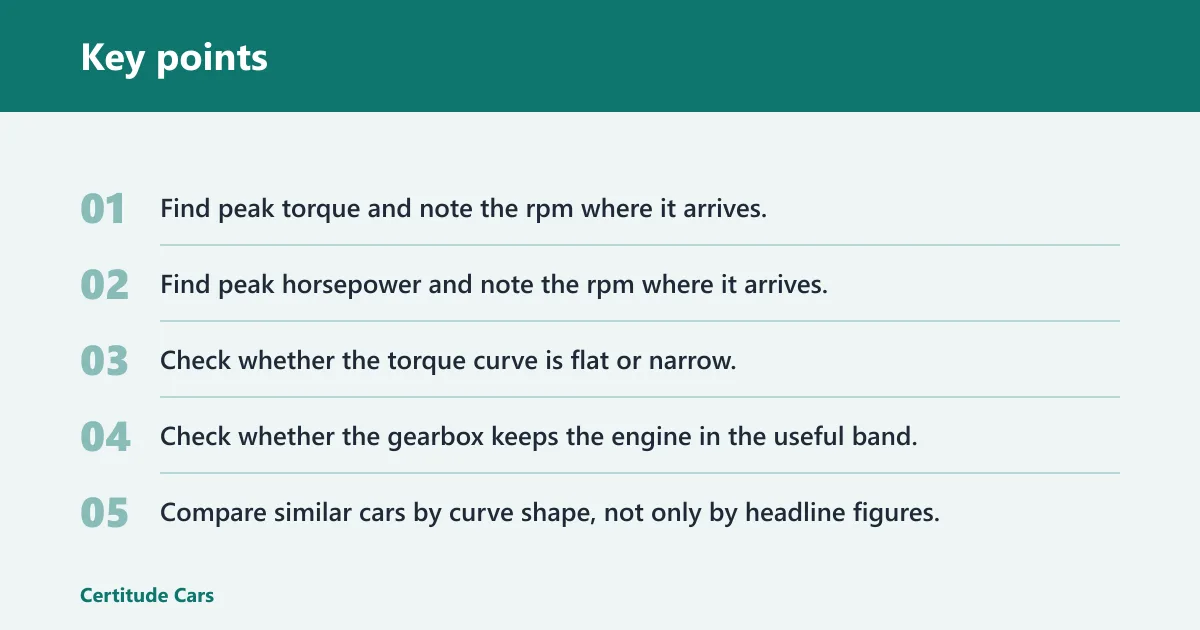
- Find peak torque and note the rpm where it arrives.
- Find peak horsepower and note the rpm where it arrives.
- Check whether the torque curve is flat or narrow.
- Check whether the gearbox keeps the engine in the useful band.
- Compare similar cars by curve shape, not only by headline figures.
Why similar horsepower can feel different
Torque curve shape
Two cars can have similar horsepower and still feel very different because their torque curves are shaped differently. A broad plateau gives steady pull across more of the rev range, while a narrow spike can feel exciting in one narrow band and ordinary everywhere else. That difference shows up in normal driving long before you reach a redline.
Picture two family hatchbacks with the same peak horsepower. One makes a wide, flat torque band from low revs, while the other needs to be spun hard to wake up. The first feels easier in traffic; the second may feel sharper only when you work the gearbox.
Gearing and transmission choice
Gearing can change the whole impression. An automatic with many ratios can keep an engine near its best output, while a manual with tall ratios may ask more of the driver. That is why the same engine can feel stronger in one car than another.
Short gearing can make modest torque feel bigger at the wheels. Tall gearing can blunt a strong engine until speed rises. Always read the gear ratios, not just the brochure headline.
Turbo lag and diesel plateau behavior
Turbo lag can create a delay before the torque arrives, so a high-torque turbo engine may feel soft for a moment and then surge. By contrast, many diesels hold a flatter torque curve, which suits towing and relaxed cruising because the pull stays steady over a useful rpm band. That is part of why diesel engines often make more than double the torque than they do horsepower.
This is also why a diesel may look modest on peak horsepower but still feel strong in the right job. Peak torque low down is useful; a broad plateau is often more useful than a single sharp spike.
Choose Engine horsepower if you want…
Choose Engine horsepower if your main use is motorway overtaking, faster acceleration at speed, or driving where the engine is kept in the upper part of its rev range. It is the better headline number for passing power and sustained pull once the vehicle is already moving.
Choose torque if you want…
Choose torque if you tow, drive in steep areas, do a lot of city stop-start travel, or want easy low-speed response without constant downshifts. It is also the better first number to read for hill starts and trailer work, especially when the peak arrives low in the rev range.
Frequently asked questions
What is the difference between horsepower and torque?
Horsepower measures the rate at which work is done, while torque measures twisting force. Torque is the better guide to launch and towing feel, and horsepower is the better guide to acceleration potential as speed rises. You need both numbers, plus rpm and gearing, to judge the full picture.
Is horsepower or torque more important for towing?
Torque is more important for towing because it shows how strongly the engine can pull from low speed. Look for peak torque low in the rev range and a wide curve, not just a high headline figure. Horsepower still matters for maintaining speed with load, but it comes second for the job.
Why do horsepower and torque curves cross at 5,252 rpm?
They cross at 5,252 rpm because of the standard imperial formula linking power, torque, and rpm. At that engine speed, the numerical values match. It is a math point on the chart, not a sign that the engine changes character at that exact revs.
How do horsepower and torque affect acceleration?
Torque helps the car get moving, while horsepower helps it keep accelerating as speed and rpm rise. Low-speed shove comes from torque, but sustained acceleration depends on power and gearing. That is why a car can feel strong off the line yet ordinary during a fast overtake.
What does lb-ft mean on a spec sheet?
lb-ft means pound-feet, a torque unit used on many spec sheets. It describes twisting force at the engine. You may also see foot-pounds or ft-lbs used for the same kind of measurement, though the wording is not always consistent across brands and markets.
What does Nm mean for torque?
Nm means newton-metre, the metric unit used for torque. It appears alongside or instead of lb-ft on many spec sheets, especially outside the United States. When you compare cars, make sure you are comparing torque figures in the same unit or converting them correctly.
Why do diesel engines usually have more torque than horsepower?
Diesels often make strong low-rpm torque and hold it over a broad band, which suits their combustion and turbo setup. That lets them pull well at low engine speeds. Because horsepower depends on rpm as well as torque, the power figure can stay lower even when the torque number looks high.