What Does Full Coverage Mean in Car Insurance?
“Full coverage” usually means liability, collision, and comprehensive insurance together. It does not pay every loss, and lenders may still want extra protection. If you read too much into the label, you can face repair bills, a totaled car with too little payout, or damage the policy does not touch. This guide breaks down what each part pays for and the gaps to check on your declarations page.
What it usually includes and why it varies
“Full coverage” is an informal bundle, not a separate policy type. It usually means liability plus comprehensive and collision, but the setup can change with state rules and lender demands. A policy can still leave out medical costs, rental costs, loan payoff risk, or items inside the car.
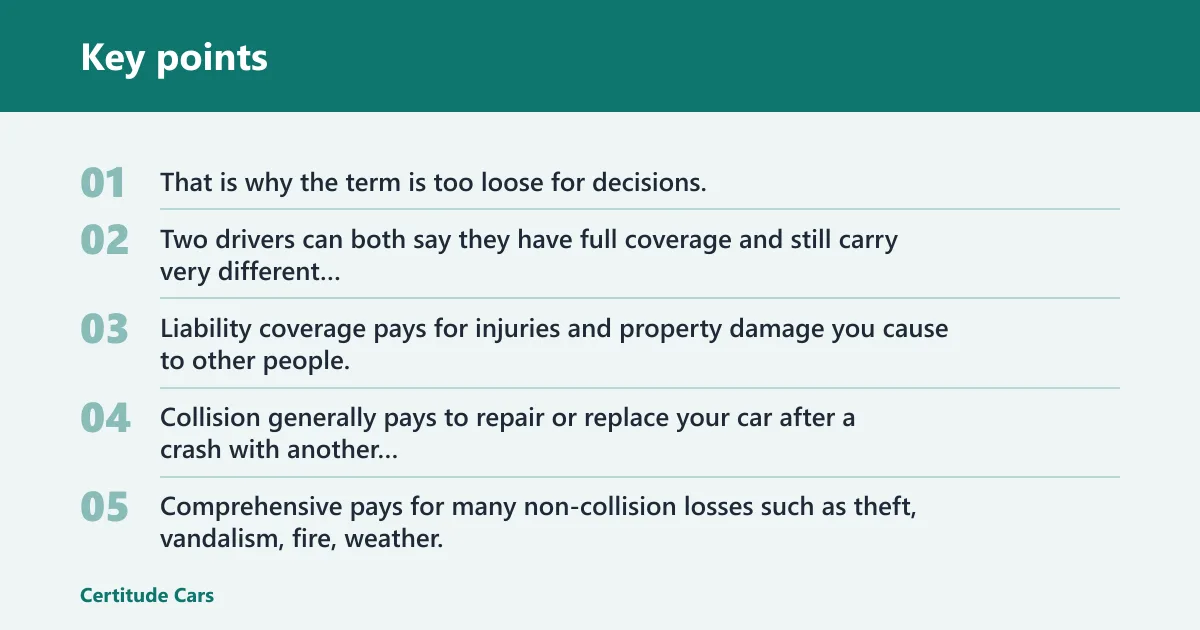
That is why the term is too loose for decisions. Two drivers can both say they have full coverage and still carry very different protection.
What it usually includes
Liability coverage pays for injuries and property damage you cause to other people. Collision generally pays to repair or replace your car after a crash with another vehicle or an object. Comprehensive pays for many non-collision losses such as theft, vandalism, fire, weather, glass damage, and animal strikes.
Liability is required in nearly every state, while comprehensive and collision are often optional in most states. Lenders often require both on leased or financed cars.
Why the term changes by state and lender
State rules can add coverages that many drivers forget to count when they say “full coverage.” No-fault states often make PIP or MedPay part of the picture, and some states require uninsured or underinsured motorist coverage. In those places, “full coverage” may mean more than liability, comp, and collision.
Progressive says no policy can protect you in all situations. U.S. News also notes that comprehensive and collision are not required in any state, and that the term has no standard definition.
What liability coverage pays
Liability coverage pays when you cause injury or property damage to someone else. It does not pay to repair your own car. It also comes with policy limits, which cap how much the insurer will pay for a covered claim.
Those limits matter because a severe crash can exceed them fast. If your liability limit is too low, you may owe the rest out of pocket.
Why liability does not fix your own car
Liability is about harm you cause to others, not your vehicle. If you rear-end a SUV, liability can pay for the other driver’s repair bill and medical claim, but your own bumper damage still depends on collision coverage, if you bought it.
Say you clip a parked car and damage both vehicles. Liability may pay for the parked car, while collision handles your car, after its deductible. Without collision, your side of the claim is yours to pay.
What comprehensive and collision cover
Collision coverage pays for damage to your car from a crash with another vehicle or an object, and it can also apply to events such as potholes and rollovers. Comprehensive coverage pays for non-collision losses such as theft, vandalism, fire, hail, flooding, falling objects, broken glass, and animals.
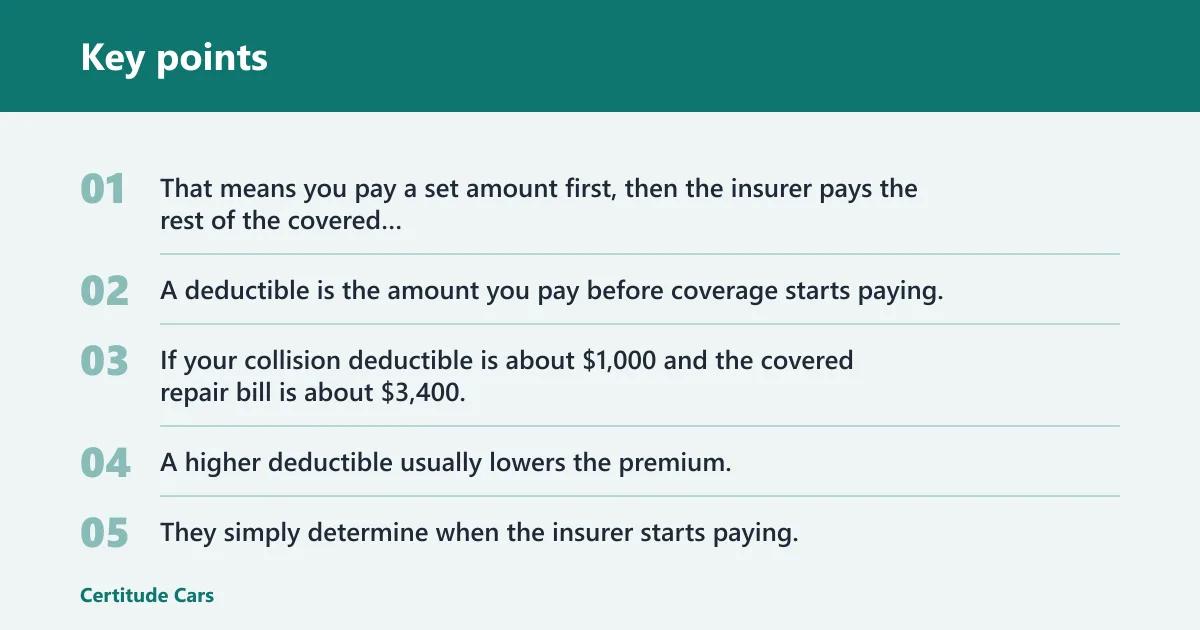
Both usually have deductibles. That means you pay a set amount first, then the insurer pays the rest of the covered loss up to the car’s value or policy terms.
How deductibles work
A deductible is the amount you pay before coverage starts paying. If your collision deductible is about $1,000 and the covered repair bill is about $3,400, you would generally receive payment after that deductible is applied. A higher deductible usually lowers the premium, but it also raises your out-of-pocket cost after a claim.
Deductibles do not erase policy limits. They simply determine when the insurer starts paying.
What comprehensive coverage means in car insurance
Comprehensive coverage pays for damage that does not come from a crash. That includes theft, vandalism, fire, weather damage, falling objects, glass breakage, and hitting an animal. It is often optional, but many lenders want it on financed or leased cars.
What collision coverage means in car insurance
Collision coverage pays to repair or replace your car after a collision, whether the other driver is identified or not. It applies to accidents with vehicles and objects, and it can also handle some impacts that do not involve another driver. You usually pay a deductible before the claim is settled.
What state rules change
State-required coverages can change what “full coverage” means on your policy. Some states require more than liability. Others add no-fault medical coverage, uninsured motorist coverage, or underinsured motorist coverage. That means the label on the quote is less important than the coverages listed on the declarations page.
In no-fault states, PIP often pays medical bills and related losses after a crash, no matter who caused it. MedPay can help with medical costs too, depending on the state and policy.
How uninsured and underinsured motorist coverage fits
Uninsured motorist coverage can pay if the other driver has no liability insurance. Underinsured motorist coverage can help when the other driver has insurance, but not enough. These coverages often matter more than shoppers expect, because they protect you against the other driver’s weak policy, not your own car damage.
If you want to know what “full coverage” means on your policy, check whether these coverages are listed separately. Do not assume they are included just because you have comp and collision.
Coverage reality check table
| Scenario | Which coverage pays first | Deductible applies? | Usually included? | Common missing add-ons |
|---|---|---|---|---|
| At-fault crash | Collision for your car; liability for the other party | Yes, for collision | Often, if you bought comp/collision | Rental reimbursement, higher liability limits |
| Hail or wind damage | Comprehensive | Yes | Often, if you bought comp | Glass coverage, rental reimbursement |
| Theft or vandalism | Comprehensive | Yes | Often, if you bought comp | Contents coverage for items inside the car |
| Totaled financed car | Comprehensive or collision, depending on cause; payout is usually ACV | Yes | Often, if comp/collision is on the policy | Gap insurance |
| Medical bills after a crash | PIP, MedPay, or health insurance, depending on state and policy | Usually no for PIP/MedPay; health insurance has its own cost-sharing | Varies by state | PIP, MedPay, bodily injury liability if you injured others |
| Stolen laptop or phone from the car | Usually no auto coverage; homeowners or renters policy may help | Depends on the other policy | No | Personal property coverage |
| Rental car after a claim | Rental reimbursement, if purchased | Usually no deductible for this add-on | No | Rental reimbursement coverage |
| Uninsured driver hits you | Uninsured motorist coverage; sometimes collision for car damage | Depends on the coverage used | Varies by state and policy | UM/UIM coverage |
| Hitting an animal | Comprehensive | Yes | Often, if you bought comp | Rental reimbursement |
| Glass-only damage | Comprehensive | Often yes, unless you have a glass waiver or special glass coverage | Often | Full glass coverage |
| Loan balance exceeds ACV | Gap insurance after the ACV payout | No deductible for gap itself; comp/collision deductible still applies first | No | Gap insurance |
| Mechanical breakdown | No standard auto coverage | Not applicable | No | Mechanical breakdown coverage or warranty |
What full coverage does not pay
Full coverage does not pay for every loss. It usually does not cover wear and tear, routine maintenance, mechanical breakdown, engine failure from age or neglect, or belongings inside the car. It also does not erase the gap between an ACV payout and what you still owe on a loan or lease.
Actual cash value, or ACV, is the amount used to settle many total loss claims. It may be less than your loan balance or less than what you would need to buy a similar replacement vehicle.
Picture a sedan with 92,000 miles that needs a transmission after a breakdown. That repair is usually outside standard auto coverage. If the car is later stolen and declared a total loss, the payout is still tied to ACV, not to the original sticker price or the remaining loan balance.
What can surprise shoppers?
- Mechanical breakdown is usually excluded.
- Routine maintenance is not a claim.
- Personal items inside the car are usually not paid by auto coverage.
- Rental transportation is not automatic.
- ACV can be lower than the payoff amount on a recent loan.
Do you need it on a financed car?
Lenders often require full coverage for leased or financed cars. That usually means liability plus comprehensive and collision, and sometimes extra proof of gap insurance if the loan balance is high. The lender wants the car protected as collateral until the loan is paid down.
Gap insurance matters when the car’s ACV drops faster than the loan balance. If the vehicle is totaled, gap coverage can pay the difference between the ACV settlement and the loan or lease balance.
- Check the lender’s insurance requirements before dropping comp or collision.
- Compare your current loan balance with the car’s likely ACV.
- Ask whether gap insurance is already included in the lease or loan.
- Review deductible amounts, since a high deductible can shrink the claim payment.
- Confirm whether rental reimbursement and UM/UIM are part of your setup.
When full coverage may be too much
Full coverage can be more than you need on an older or paid-off car. If the vehicle’s ACV is low, the cost of comp and collision may take up a large share of the car’s remaining value. At that point, the premium may buy less real protection than the shopper expects.
The tradeoff is simple. Dropping comp and collision lowers the premium, but it also shifts repair and total-loss risk onto you.
A common first-timer mistake is keeping a $1,500 collision deductible on a car worth about $3,000 and assuming the claim will feel worthwhile. After the deductible, the payout may be too small to justify years of extra premium. The better move is to compare premium, deductible, and likely ACV side by side.
How to decide
- Keep comp and collision when the car still has meaningful ACV.
- Recheck the value after major mileage jumps or age milestones.
- Compare the annual premium against the most likely payout.
- Do not drop liability; nearly every state requires it.
- Consider whether you could cover a repair or replacement bill yourself.
Frequently asked questions
What does full coverage mean in car insurance?
“Full coverage” usually means liability, comprehensive, and collision insurance together. It is an informal label, not a policy type, and it does not guarantee payment for every loss. State rules, lender rules, deductibles, and limits can change what you actually have.
What does full coverage car insurance include?
It commonly includes liability, comprehensive, and collision coverage. Liability pays others for injuries and property damage you cause. Comprehensive and collision pay for your car, but each usually has a deductible, and many policies still leave out rental reimbursement, gap insurance, and medical add-ons.
Does full coverage car insurance cover everything?
No. It does not usually cover wear and tear, mechanical breakdown, routine maintenance, or personal belongings inside the car. It also may not cover the full payoff on a loan if the car’s actual cash value is lower than what you owe.
What does comprehensive coverage mean in car insurance?
Comprehensive coverage pays for non-collision losses such as theft, vandalism, fire, hail, flooding, falling objects, broken glass, and animal strikes. It is optional in most states and usually comes with a deductible. It does not pay for crash damage between cars.
What does collision coverage mean in car insurance?
Collision coverage pays to repair or replace your car after a crash with another vehicle or an object. It can also apply to rollovers and some pothole damage. It is optional in most states, and a deductible usually applies before payment starts.
Do you need full coverage on a financed car?
Often, yes. Lenders commonly require comprehensive and collision on financed or leased cars, and they may also want proof of gap insurance in some cases. That protects the lender’s interest if the vehicle is totaled before the loan balance has dropped enough.