How Does Liability Insurance Work After a Car Accident?
Liability insurance pays the other party after a crash, up to your policy limits, when you’re at fault. It does not pay for your own vehicle damage or injuries unless another part of your policy applies. If the claim goes past the limits, you can still owe the unpaid balance. This guide shows who pays, when liability coverage starts and stops, and where the remaining costs usually land.
What liability insurance pays
Liability insurance pays for losses you cause to other people in a crash. The two core parts are bodily injury liability and property damage liability. Bodily injury liability can cover medical expenses, lost wages, and pain and suffering for injured others. Property damage liability can cover damage to another vehicle, a fence, a building, or another structure.
Bodily injury liability
Bodily injury liability applies when someone else is hurt and you are found at fault in whole or in part. It can pay the injured person’s medical bills, missed income, and related pain and suffering, subject to your policy limits. It does not pay for your own injuries.
Property damage liability
Property damage liability pays for damage to another person’s car and other property you damage in the crash. In some claims, it may also help with legal expenses tied to a lawsuit. It does not pay to repair your own car.
What it does not cover
Liability coverage is for damage you cause to others. It does not cover your own car repairs, your own medical care, or every cost tied to the crash. If you want help with your own losses, you usually need collision coverage for your car and med pay or PIP for medical bills, if those options are on your policy.
Who pays after a crash?
After a crash, the at-fault driver’s insurer usually pays first, after it reviews the claim and determines liability. If you were not at fault, your own insurer may still need notice, especially if you have collision coverage, med pay, or uninsured/underinsured motorist coverage that may apply. Payment follows the policy terms, not the crash scene alone.
The at-fault driver’s insurer
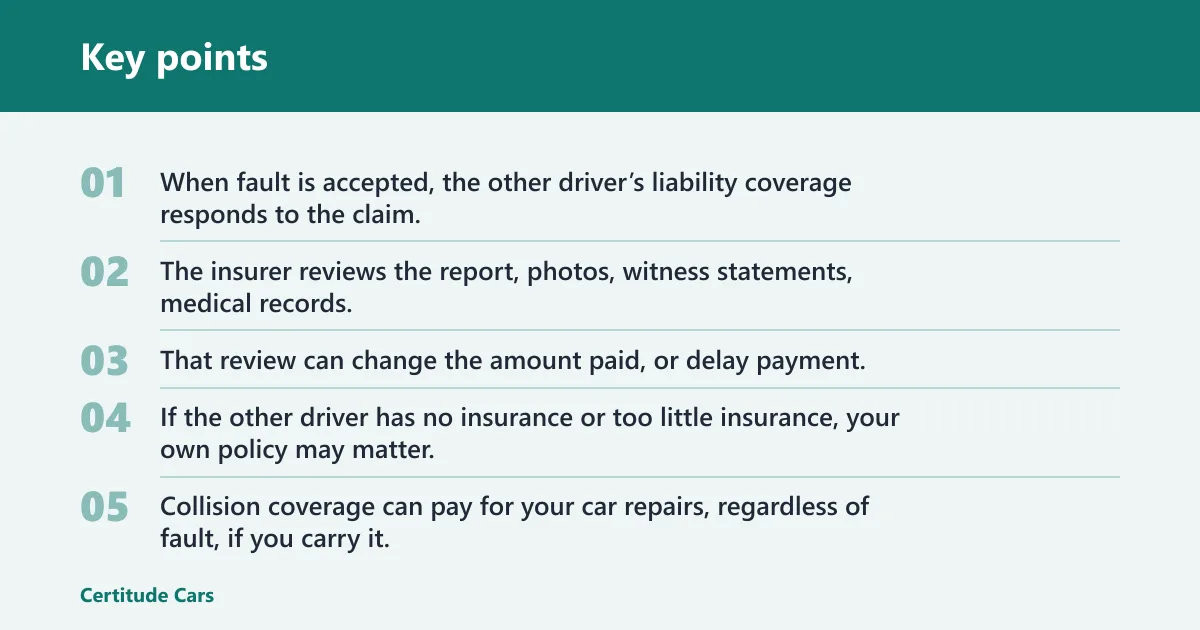
When fault is accepted, the other driver’s liability coverage responds to the claim. The insurer reviews the report, photos, witness statements, medical records, and repair estimates before it pays. That review can change the amount paid, or delay payment, if fault is disputed or documentation is missing.
The injured driver’s own coverage
If the other driver has no insurance or too little insurance, your own policy may matter. Collision coverage can pay for your car repairs, regardless of fault, if you carry it. Medical payments coverage or personal injury protection can help with medical costs under your policy terms. Uninsured and underinsured motorist coverage can act as a backstop for injuries in many situations.
When you may still notify your insurer
You may still need to report the crash to your own insurer even if you were hit by someone else. That matters when your policy could help with repairs, medical bills, rental coverage, or a claim against an uninsured or underinsured driver. It also helps protect you if the other company delays or disputes the claim.
How the claim process works
The claim process usually starts at the scene and moves through reporting, evidence collection, adjuster review, and a payment decision. The insurer does not pay automatically just because a police report exists. It decides whether the insured driver was at fault, what losses are covered, and how much remains within the policy limits.
Crash report and evidence
After the crash, the insurer looks for the basic facts: who was involved, where the impact happened, and what the damage looks like. Photos, police reports, witness statements, dashcam video, and repair estimates help the adjuster build the claim file. Medical records matter when injuries are part of the claim.
Adjuster review
The insurance adjuster reviews the facts and decides how the coverage applies. That can include asking for medical bills, wage records, repair estimates, proof of treatment, and vehicle photos. If the adjuster cannot confirm fault or cannot verify the loss, payment may be reduced, delayed, or denied.
Settlement or denial
If the insurer accepts the claim, it may offer a settlement for the covered loss. If liability is unclear, the claim may be denied or only partly paid. A claim can also stay open while treatment continues, which is common in injury cases because final medical costs are not known right away.
How liability insurance work table
| Scenario | Who files the claim | Which coverage responds | What documents are usually requested | What gets paid first | What remains out of pocket |
|---|---|---|---|---|---|
| You are not at fault, and the other driver has enough liability coverage | You file against the at-fault driver’s insurer | That driver’s bodily injury liability and property damage liability | Police report, photos, repair estimate, medical bills, treatment notes, wage proof if you missed work | Repair costs, then covered injury costs up to the policy limits | Any loss not documented, any disputed charge, and anything beyond the policy limits |
| The other driver is at fault, but their limits are too low | You file against the at-fault driver’s insurer and may also file under your own policy | The other driver’s liability coverage first; then your uninsured/underinsured motorist coverage if available | Same items as above, plus your policy declarations page and proof of your losses | The at-fault insurer pays up to its limit first, then any available UIM coverage may help with the rest | The gap above the liability limit, plus any deductible or uncovered loss |
| You are at fault | The injured other driver files against your insurer | Your bodily injury liability and property damage liability | Crash report, photos, repair estimate, injury records, wage records, and any lawsuit papers if filed | The other person’s covered losses, first to the policy limits | Your own car repairs, your own injuries, and any amount above your liability limits |
What are policy limits?
Policy limits are the ceiling on what the insurer will pay. They matter because even a valid claim can run past the limit quickly in a serious crash. Once the policy limit is reached, the insurer stops paying, even if the injured person still has medical bills, lost wages, or property loss left over.
Per-person and per-accident limits
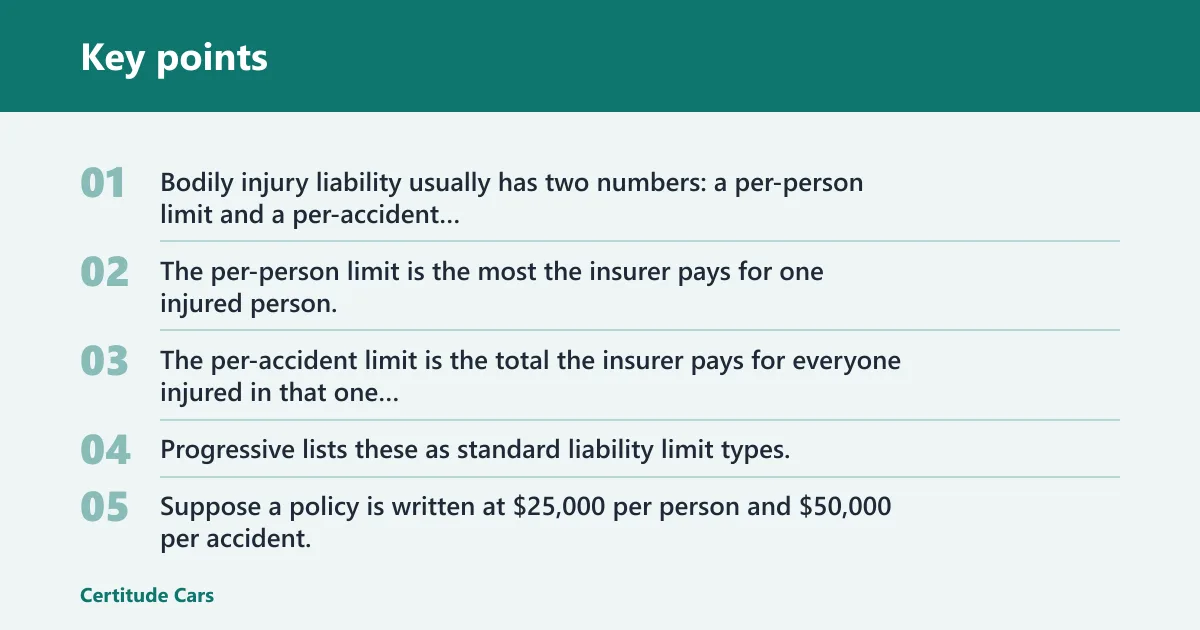
Bodily injury liability usually has two numbers: a per-person limit and a per-accident limit. The per-person limit is the most the insurer pays for one injured person. The per-accident limit is the total the insurer pays for everyone injured in that one crash. Progressive lists these as standard liability limit types.
Suppose a policy is written at $25,000 per person and $50,000 per accident. One injured person with $40,000 in covered medical and wage losses may collect up to $25,000 from that policy, not the full amount. If two people are injured, the total payment still cannot pass $50,000.
Property damage limits
Property damage liability has its own per-accident limit. It pays for vehicle repair or replacement and other property damage, such as a broken gate or storefront damage, up to that cap. California minimum liability limits are $30,000 per person, $60,000 per accident, and $15,000 for property damage. The same source gives Illinois minimum limits as $25,000/$50,000/$20,000.
When losses exceed limits
When losses exceed limits, the unpaid amount can become the injured person’s problem or the at-fault driver’s personal expense. That may lead to collection efforts or a lawsuit against the at-fault driver. State minimums are required to drive legally in many places, but they can still be too low for a serious crash.
What if fault is shared?
Shared fault can reduce compensation. If more than one driver contributed to the crash, the amount paid may be reduced by each driver’s percentage of responsibility. Rules vary by state, and the insurer’s fault decision can change after new evidence comes in. Comparative negligence is often a major reason a claim pays less than expected.
Comparative negligence
Comparative negligence means each driver’s share of fault matters. If you are found 20% responsible, your recovery may be reduced by 20%, depending on the state’s rule. That can affect both injury and property claims, and it can lower the amount the other insurer pays.
Disputed liability claims
If fault is disputed, the adjuster may hold the claim while it gathers more evidence. That can include scene photos, video, witness statements, point-of-impact evidence, and repair records. A denial is possible if the insurer decides its driver was not at fault or if the proof is too thin to support payment.
A common first-timer mistake is assuming the police report alone settles fault. It helps, but the insurer still makes its own liability decision based on the full file.
What if the other driver lacks enough insurance?
If the at-fault driver has no insurance or too little insurance, liability coverage may not fully pay your losses. Uninsured motorist coverage and underinsured motorist coverage can help fill that gap, if your policy includes them. These are backstop coverages, not the same thing as the other driver’s liability insurance.
Uninsured motorist coverage
Uninsured motorist coverage may help when the at-fault driver has no liability insurance at all. Depending on the policy and state rules, it can help with injury losses that the other driver cannot pay. It is meant to protect you when liability coverage is unavailable.
Underinsured motorist coverage
Underinsured motorist coverage may help when the at-fault driver has insurance, but the limits are too low for the injury claim. It can help pay the gap between the other driver’s limit and your covered loss, up to your own policy terms. It does not erase the fact that the first policy may run out early.
State minimum limits
State minimum liability requirements vary by state. They are often required to drive legally, but they may be low compared with the cost of a serious injury claim. That is why a claim can be covered and still leave unpaid bills after the insurer reaches its cap.
Frequently asked questions
How does liability insurance work in an accident?
Liability insurance pays for injuries and property damage you cause to other people if you are found at fault, up to the policy limits. The insurer investigates first, using reports, photos, and records. It does not pay your own injuries or your car repairs unless another coverage on your policy applies.
Does liability insurance pay for my car repairs after a crash?
No. Liability insurance does not repair the at-fault driver’s own car. It pays for damage to other people’s property. If you want your own car repaired after a crash you caused, collision coverage is the part of the policy that usually matters.
Does liability insurance cover my injuries after a crash?
No. Liability coverage does not pay for the at-fault driver’s own injuries. It is designed for the other party’s losses. Medical payments coverage, personal injury protection, or health insurance may be the next places to check, depending on what you carry.
What happens if the at-fault driver’s liability limits are too low?
Payment stops when the limits are reached. The injured person may recover only part of the loss from that policy and may need to look to underinsured motorist coverage, if available, for the rest. Any unpaid balance can remain open or become a personal claim against the at-fault driver.
Do I still have to report an accident to my insurer if I wasn’t at fault?
Often, yes. Reporting the crash can protect your ability to use collision coverage, med pay, or uninsured and underinsured motorist coverage if needed. It also creates a record in case the other insurer delays, denies, or disputes the claim later.
How are liability claims handled when fault is disputed?
The insurer investigates before it accepts liability. The adjuster compares the police report, damage photos, witness statements, and other evidence. If fault remains unclear, the claim may be delayed, reduced, or denied until the insurer has enough proof to decide who should pay and how much.